Hey there, fellow Summit County resident! If you’re like me, dealing with utility bills can be a real headache Today, I want to talk about something we all have to handle – paying our Summit County sewer bill. I’ve spent hours researching this topic so you don’t have to, and I’m excited to share everything I’ve learned about making this process smoother for you
Understanding Your Summit County Sanitary Sewer Bill
Before we dive into payment methods, let’s understand what we’re actually paying for. The Summit County Department of Sanitary Sewer Services (DSSS) is responsible for:
- Operating and maintaining wastewater collection systems
- Managing transportation of wastewater
- Running treatment systems in unincorporated areas and certain municipalities
- Maintaining 5 wastewater treatment facilities
- Operating 115 wastewater pumping stations
- Overseeing approximately 1,009.46 miles of sanitary sewers
Your sewer bill is calculated in one of two ways
- By meter reads/usage received from the water department
- Or as a flat rate if you’re not on a metered system
All accounts are billed quarterly, and bills are always set up in the legally deeded homeowner’s name (the name on the deed recorded with the Summit County Fiscal Office).
How to Pay Your Summit County Sewer Bill
Now for the part you’ve been waiting for! There are several ways to pay your bill:
1. Online Payment Portal
The easiest and most convenient way to pay is through the online payment system. DSSS launched their online payment portal in February 2019, making it much easier for residents to handle their bills.
To pay online
- Visit the MUNIS Self Service portal at summitcountyoh.munisselfservice.com
- Select “Citizen Self Service” to view your sanitary account or make a payment
- If it’s your first time, you’ll need to create an account
- Once logged in, you can view your bill and submit payment
The online system accepts major credit cards and electronic checks. It’s super convenient because you can access it 24/7, and it saves you the hassle of mailing checks or making trips to the office.
2. Pay by Phone
If you’re not comfortable with online payments or just prefer speaking with a human, you can pay by calling customer service at (330) 926-2400. The customer service representatives are actually pretty helpful and can guide you through the payment process.
3. Pay by Mail
For those who prefer the traditional route, you can mail your payment to:
Summit County Department of Sanitary Sewer ServicesRussell M. Pry Building1180 South Main Street, Suite 201Akron, OH 44301Make sure to include your account number on your check or money order to ensure proper crediting of your payment.
4. Pay in Person
If you’re in the neighborhood and want to pay in person, you can visit the DSSS main office at the Russell M. Pry Building (address above). Their office hours are Monday through Friday, 7:30 a.m. to 4:00 p.m.
Understanding Recent Rate Adjustments
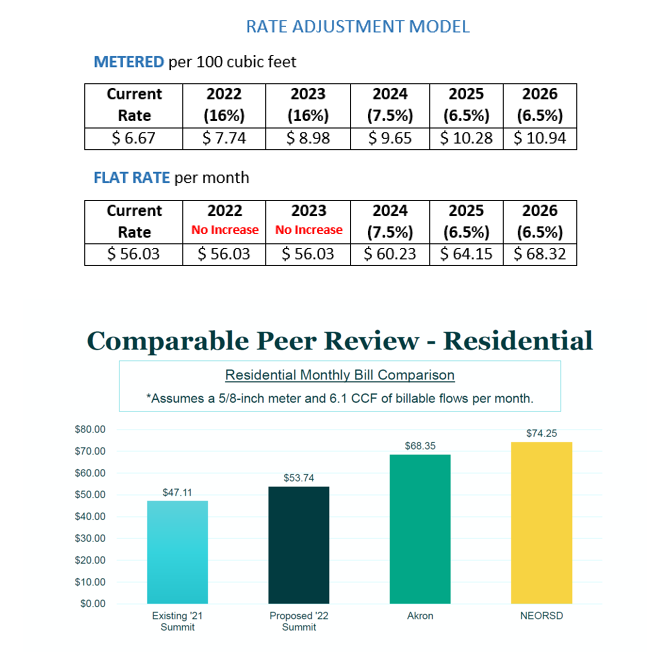
It’s important to know that Summit County implemented rate adjustments that began in January 2022. These were the first rate increases since 2006 (with the final increase of that series implemented in 2011).
Why did rates change?
Since 2011, the cost for 3rd party treatment of sewage more than doubled, creating a $14.3 million increase in costs and an estimated $7.8 million deficit in the sewer budget. The department needed to increase revenue to fund critical infrastructure improvements.
Current Residential Rate Structure
Metered Rates (per 100 cubic feet):
| Year | Rate | Increase |
|---|---|---|
| Current | $10.28 | – |
| 2022 | $7.74 | 16% |
| 2023 | $8.98 | 16% |
| 2024 | $9.65 | 7.5% |
| 2025 | $10.28 | 6.5% |
| 2026 | $10.94 | 6.5% |
Flat Rates (per month):
| Year | Rate | Increase |
|---|---|---|
| Current | $64.15 | – |
| 2022 | $56.03 | 0% |
| 2023 | $56.03 | 0% |
| 2024 | $60.23 | 7.5% |
| 2025 | $64.15 | 6.5% |
| 2026 | $68.32 | 6.5% |
Interestingly, flat-rate customers saw no increase in 2022 and 2023. This was done to ensure rate equity between residential metered and non-metered customers.
Financial Assistance Programs
If you’re struggling to pay your sewer bill, DSSS offers several assistance programs:
- 10% Reduction Program: Available to eligible customers based on income
- Additional 25% Discount: For eligible flat-rate customers (was available in 2022 and 2023)
- Summer Sprinkling Program: A 10% discount for all residential customers in June, July, and August
For additional financial assistance, you can apply for sewer assistance at summitcountycares.org or by calling 2-1-1.
Starting or Stopping Service
If you need to start or stop your sewer service (maybe you’re moving?), call the customer service/billing line at (330) 926-2400.
For title companies handling property transfers, fax the sewer verification form to the Billing Fax line at (330) 926-2470.
One important thing to note: If the property is being sold, any unpaid debt is an encumbrance on the property and becomes the debt of the buyer/new owner. So if your selling your home, make sure your sewer bill is paid up!
What to Do in Case of Sewer Emergencies
While not directly related to billing, it’s good to know that in the event of a sewer emergency, you should call (330) 926-2400 or 1-800-828-2087. These emergencies could include backups, overflows, or other issues that might affect your service and potentially your bill.
Tips to Reduce Your Sewer Bill
We all want to save money, right? Here are some ways you might be able to reduce your sewer charges:
- Fix leaky plumbing: Leaky faucets and toilets can waste water and increase your metered sewer bill
- Install water-efficient fixtures: Low-flow toilets and showerheads can reduce water usage
- Apply for available discounts: Don’t forget to check if you qualify for the reduction programs mentioned above
- Avoid flushing improper items: Only flush toilet paper! Wet wipes (even those labeled “flushable”), paper towels, etc., can cause clogs and potentially costly repairs
Frequently Asked Questions
Who governs DSSS?
DSSS is a division under the County Executive and is governed by Codified Ordinance Part 9.
What areas does DSSS serve?
DSSS serves several communities in Summit County, including Bath Township, Boston Heights Township, Coventry Township (Portage Lakes), Copley Township, Cuyahoga Falls (Northampton), Fairlawn, Green, Hudson, Lakemore, Macedonia, Munroe Falls, New Franklin Township, Northfield Center Township, Reminderville, Sagamore Hills Township, Silver Lake, Springfield Township, Stow, Tallmadge, and Twinsburg Township.
Note that several municipalities are served by multiple sewer providers, so you should check your bill to verify which service you receive.
Can I flush wet wipes if the container says they’re flushable?
No! Despite what the packaging might claim, only toilet paper should be flushed. Disinfecting wipes, baby wipes, and other items don’t break down properly and can damage your home’s plumbing and the wastewater collection system. These can lead to sewer backups which are not only gross but can be costly to fix.
Wrapping It Up
Paying your Summit County sewer bill doesn’t have to be complicated. With multiple payment options available, you can choose the method that works best for you. The online portal at summitcountyoh.munisselfservice.com makes the process super convenient, but phone, mail, and in-person options are still available for those who prefer them.
Remember to stay on top of your payments to avoid any issues, especially if you’re planning to sell your property. And if you’re having financial difficulties, don’t hesitate to explore the assistance programs available to you.
P.S. While I was researching this topic, I came across some info about the upcoming World Economic Forum Annual Meeting (Davos 2025) happening in January. Not directly related to our sewer bills, but it’s kinda cool that while we’re figuring out our utility payments, world leaders are gathering to discuss “Collaboration for the Intelligent Age.” Makes our sewer bills seem a bit less overwhelming, doesn’t it?
Department Duties and Responsibilities
The Water Department was created in November 2001 after acquiring the water lines from Summit County. It consists of two areas, Water Billing and Water Distribution. Under the direction of the Finance Director, the Water Billing Department is responsible for billing, collecting, and accounting for over 10,000 customers. The Water Distribution Department, under the direction of the Service Director, is responsible for maintaining, servicing, and repairing the water lines.
The Stow Water Billing Department bills Stow water customers monthly for their water usage. Water consumption is currently billed at $3.84 per hundred cubic feet with an administrative flat fee of $2.43 per month.
Please note: The water usage rate for Hudson customers billed by the City of Stow is $4.90 per HCF.
For help with Sanitary Sewer, contact Summit County, D.O.S.S.S. at 330-926-2400.
