NPS has its own set of benefits and limitations, which you need to carefully analyse before investing in it. If choosing to invest in NPS is your decision, then remember to check the key benefits and limitations that tag along. In this blog, we will talk about the significant National Pension System benefits so that you can make an informed decision for your financial future.
Are you worried about your post-retirement life? Wondering how you’ll manage finances when you’re no longer earning a regular income? The National Pension System (NPS) might just be the solution you’re looking for!
I’ve been researching retirement options for quite some time now, and NPS consistently stands out as one of the best long-term investment plans for securing your golden years. Let’s dive deep into what NPS is all about and why it could be a game-changer for your retirement planning.
What is the National Pension System (NPS)?
The National Pension System is a government-sponsored pension scheme launched on January 1, 2004. It was initially introduced for new government recruits (except armed forces) but was later extended to all citizens of India on a voluntary basis from May 1, 2009.
NPS aims to provide financial security and stability during old age when people don’t have a regular source of income. It’s regulated by the Pension Fund Regulatory and Development Authority (PFRDA), which was established on October 10, 2003, to develop and regulate India’s pension sector.
The primary objective of NPS is to
- Institute pension reforms
- Inculcate the habit of saving for retirement among citizens
- Provide a structured platform for retirement planning
Who Can Join NPS?
The eligibility criteria for joining NPS are pretty straightforward:
- You must be an Indian citizen (resident or non-resident)
- You should be between 18 and 70 years of age
- You need to comply with Know Your Customer (KYC) norms
- You should be legally competent to execute a contract as per the Indian Contract Act
It’s important to note that Overseas Citizens of India (OCIs), Persons of Indian Origin (PIOs), and Hindu Undivided Families (HUFs) are not eligible to subscribe to NPS. Also, NPS is an individual pension account, so it cannot be opened on behalf of a third person.
Types of NPS Accounts
NPS offers two types of accounts to cater to different investment needs:
1. Tier-I Account
This is a non-withdrawable retirement account and forms the basis of the NPS. Key features include:
- Mandatory for: Government employees; optional for others
- Minimum contribution: Rs. 500 per contribution and Rs. 1,000 per year
- Withdrawals: Restricted until age 60 (partial withdrawals allowed in specific cases)
- Tax benefits: Available under Section 80C (up to Rs. 1.5 lakh) + Section 80CCD(1B) (additional Rs. 50,000)
2. Tier-II Account
This is a voluntary savings facility that offers more flexibility. Features include
- Eligibility: Only those who have an active Tier-I account
- Minimum contribution: Rs. 250 per contribution (no annual minimum)
- Withdrawals: Fully flexible – can withdraw anytime
- Tax benefits: Generally no tax benefits, except for government employees (under Section 80C with 3-year lock-in)
Latest Updates on NPS in 2025
The government has launched the Unified Pension Scheme (UPS) effective from April 1, 2025, available to central government employees and retired NPS subscribers. Retired NPS subscribers now have the option to migrate from NPS to UPS.
Unlike NPS, UPS offers a guaranteed minimum pension amount of Rs. 10,000. The tax benefits provided to NPS have also been extended to UPS.
Investment Options in NPS
One of the things I love about NPS is its flexibility in investment choices. There are two primary ways to invest:
1. Active Choice
You can actively choose how your funds are allocated across different asset classes:
- Equity (E): Max cap of 50-75% (50% for government employees and senior citizens)
- Corporate Bonds (C)
- Government Securities (G)
- Alternative Investment Funds (A)
2. Auto Choice (Lifecycle Fund)
If you’re not confident about making investment decisions, this option automatically adjusts your portfolio based on your age:
- The younger you are, the higher your equity exposure
- As you grow older, the allocation gradually shifts toward less risky options
Benefits of NPS: Why Should You Consider It?
Now, let’s talk about the real reason you’re here – the benefits of NPS!
1. Tax Benefits
NPS offers some fantastic tax advantages:
For Tier-I Account:
- Self-contribution: Deduction of up to Rs. 1.5 lakh under Section 80CCD(1) within the overall limit of Section 80CCE
- Additional deduction: Exclusive Rs. 50,000 deduction under Section 80CCD(1B)
- Employer’s contribution: Deduction up to 10% of salary under Section 80CCD(2) (14% for central government employees)
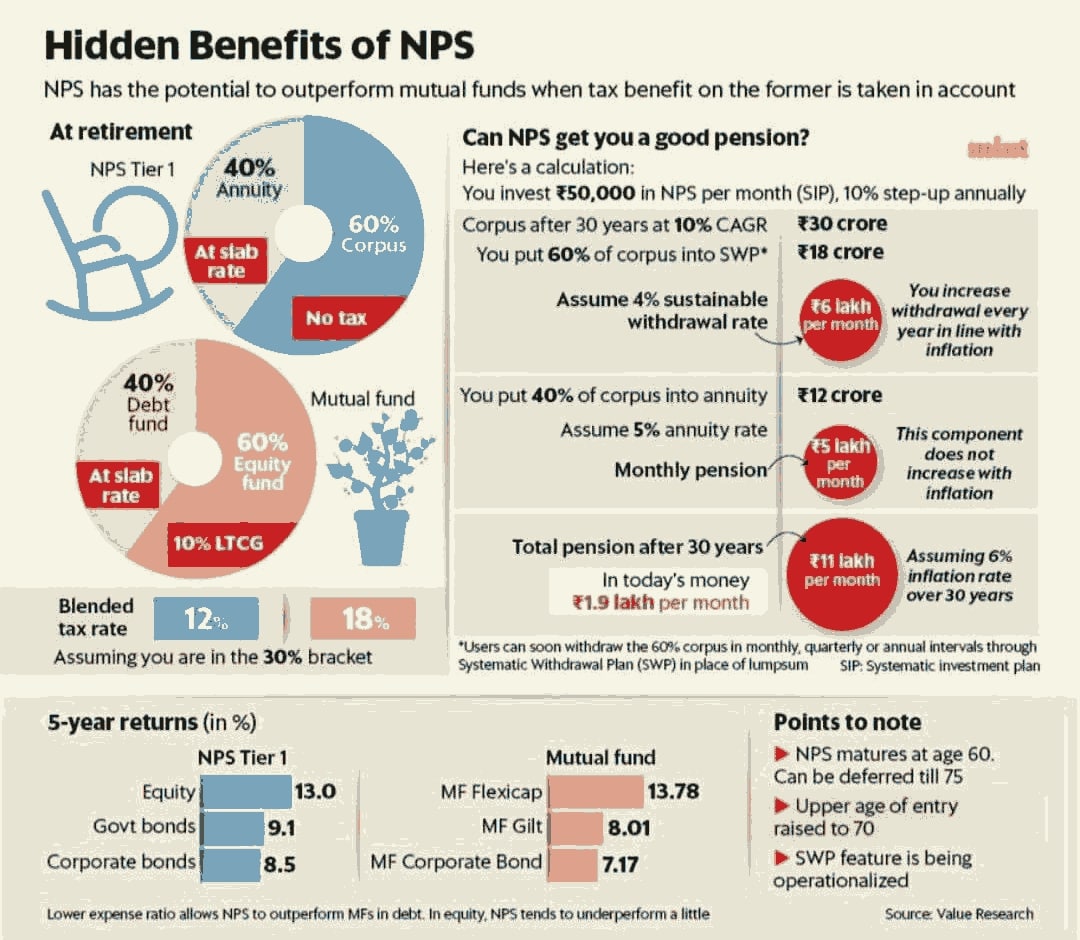
- Withdrawal benefits: 60% of the corpus withdrawn as a lump sum is tax-free
For Tier-II Account (with 3-year lock-in):
- Deduction under Section 80C up to Rs. 1.5 lakh (subject to the overall limit)
2. Low Fund Management Charges
NPS has one of the lowest fund management charges in the industry, typically around 0.01% to 0.03%. This means more of your money goes toward your retirement corpus rather than fees.
3. Market-Linked Returns
Unlike fixed-interest schemes, NPS gives you the opportunity to earn potentially higher returns through market-linked investments. Historical performance shows returns ranging from 11% to 20% annualized, though past performance doesn’t guarantee future results.
4. Flexibility and Portability
- You can change your fund manager once a year if you’re not satisfied with their performance
- The account is portable across jobs and locations
- You can operate your account online from anywhere
- Contributions can be made at any time during the financial year
5. Partial Withdrawal Facility
After three years of joining NPS, you can withdraw up to 25% of your contributions (not the total corpus) for specific purposes like:
- Higher education of children
- Marriage of children
- Purchase/construction of residential house
- Treatment of specified illnesses
6. Systematic Withdrawal Plan
Upon retirement, you can opt for a systematic withdrawal plan at regular intervals (monthly, quarterly, half-yearly, or yearly) instead of taking a lump sum.
NPS Withdrawal Rules
Understanding the withdrawal rules is crucial before investing in any long-term scheme:
Upon Reaching 60 Years or Superannuation:
- You can withdraw up to 60% of the corpus as a lump sum (tax-free)
- The remaining 40% must be used to purchase an annuity that provides monthly pension
- If your total corpus is up to Rs. 5 lakh, you can withdraw the entire amount without buying an annuity
Premature Exit (Before 60 Years):
- At least 80% of the pension corpus must be used to purchase an annuity
- If the total corpus is less than or equal to Rs. 2.5 lakh, you can opt for 100% lump sum withdrawal
Upon Death of the Subscriber:
- The entire accumulated corpus (100%) is paid to the nominee/legal heir
NPS vs Other Retirement Options
Let’s compare NPS with some popular retirement options:
| Feature | NPS | PPF | EPF | UPS |
|---|---|---|---|---|
| Returns | Market-linked (11-20%) | Fixed (7.1% currently) | Fixed (8.15% currently) | Guaranteed minimum pension |
| Tax benefits | Up to Rs. 2 lakh | Up to Rs. 1.5 lakh | Tax exempt | Same as NPS |
| Lock-in period | Until retirement | 15 years | Until retirement | Until retirement |
| Liquidity | Partial withdrawal allowed | Partial withdrawal allowed | Partial withdrawal allowed | Limited |
| Min. pension amount | No guarantee | N/A | N/A | Rs. 10,000 guaranteed |
How to Open an NPS Account?
Opening an NPS account has become super easy! You can do it in less than 30 minutes online. Here’s how:
- Visit enps.nsdl.com
- Link your account to your PAN, Aadhaar, and mobile number
- Validate the registration using the OTP sent to your mobile
- This will generate a PRAN (Permanent Retirement Account Number)
- Use this PRAN for future NPS logins
Alternatively, you can visit any Point of Presence (POP) like banks or post offices to open your account.
NPS Charges
Understanding the charges involved is important for any investment decision:
| Intermediary | Charge Head | Service Charges |
|---|---|---|
| CRA | PRA Opening charges | Rs. 50 |
| CRA | Annual PRA Maintenance cost | Rs. 190 |
| CRA | Charge per transaction | Rs. 4 |
| POP | Initial subscriber registration | Rs. 100 |
| POP | Initial contribution upload | 0.25% (min Rs. 20, max Rs. 25,000) |
| POP | Subsequent contribution | 0.25% (min Rs. 20, max Rs. 25,000) |
| POP | Non-contribution transaction | Rs. 20 |
Is NPS Right for You?
While NPS offers numerous benefits, it may not be suitable for everyone. Consider these factors:
- Long-term commitment: NPS is primarily a retirement-focused investment with limited liquidity
- No guaranteed returns: Unlike some government schemes, returns are market-linked
- Mandatory annuity purchase: You must use at least 40% of the corpus to buy an annuity
In my opinion, NPS is excellent for those who:
- Are disciplined savers looking for a long-term retirement solution
- Want additional tax benefits beyond the standard Section 80C options
- Prefer a regulated, government-backed pension system
- Are comfortable with some market exposure for potentially higher returns
Final Thoughts
The National Pension System is a well-structured retirement plan that helps you build a substantial corpus for your golden years while enjoying tax benefits along the way. Its flexibility in investment choices, low charges, and tax advantages make it an attractive option for retirement planning.
I’ve personally started investing in NPS a couple years back, and the experience has been pretty smooth. The online portal is user-friendly, and the ability to track my investments has given me peace of mind about my retirement planning.
Remember, retirement planning should start early. As the saying goes, “The best time to plant a tree was 20 years ago. The second best time is now.” So, if you haven’t started planning for your retirement yet, perhaps it’s time to consider NPS as an option!
Have you already invested in NPS or are you planning to? What other retirement plans do you have? Share your thoughts and experiences in the comments below!
Limitations Under NPS (National Pension System)
Benefits and limitations of NPS should be understood before investing. Several benefits have been offered under the National Pension Scheme (NPS) but at the same time certain limitations also exist that any potential investors should consider.
- Limited Liquidity: A big limitation is that the withdrawals from NPS are limited until retirement. However, you can make partial withdrawals, which are allowed only under specific conditions after completing a few years.
- Mandatory Annuity Purchase: NPS asks you to make a compulsory 40% annuity purchase at maturity. This means you may be offered lower returns compared to market-linked investments.
- Tax on Annuity Income: The annuity income received post-retirement is taxable, which may reduce your net retirement income.
- Market-Linked Risks: Though returns are higher than traditional savings plans, they are not assured and depend on market performance.
- Limited Investment Flexibility: You can choose asset allocation within limits, but cannot freely switch between multiple investment products.
- Complex Exit Rules: Early exits and withdrawals involve complex rules, which may not suit everyone’s needs.
Benefits of NPS (National Pension System) Scheme
The National Pension System (NPS) scheme provides several benefits for those looking for options to have a secure retirement with a strategic planning
Two major options for investment management come with NPS: Auto Choice and Active Choice. Your investments are handled by fund managers who diversify them across equity, corporate bonds and government securities as per their competency under the Auto Choice option. Conversely, Active choice gives you power to do asset allocation on your own thus guidelines to allow 75% of the total amount invested in equities till the age of 50 years, among other investment decisions.
One of its interesting features is that NPS allows partial withdrawals from Tier I accounts. Partial withdrawals from Tier I accounts are allowed after three years of subscription, with up to 25% of contributions allowed for specific purposes such as higher education, marriage, or medical treatment. Maximum three such withdrawals can be made with a gap of at least five years between each withdrawal. The condition of withdrawal after 5 years gap is waived for medical treatment and for those who subscribe after 60 years of age.
Large tax reliefs are given by the NPS scheme. Section 80CCD(1) grants tax deduction till Rs. 1,50,000 for contribution made towards the scheme annually. Besides Section 80CCD(2) provides tax benefits for employer contributions up to 10% of the employees salary (basic + DA). There is a further provision for voluntary contributions up to Rs. 50,000 exempted from tax purposes in this regard when he pays employees’ statutory retirement benefits like pension contributions etc.
Learn more about NPS tax benefits
Low Cost: NPS is a cost-effective investment option, with low fund management charges. This way, you can be sure that more of your money is invested toward building a large retirement corpus.
Power of Compounding: With regular contributions, NPS calls for a long-term investment where you can watch your money grow exponentially through compounding.
All you need to know about NPS (National Pension Scheme) by CA Rachana Ranade
FAQ
How does the NPS scheme work?
At retirement, subscribers can withdraw part of the accumulated funds, while the remainder is converted into a monthly pension, providing a stable income in later years. Initially, the NPS scheme was mandatory for Central Government employees joining on or after January 1, 2004.
What are the benefits of NPS?
However, there must be a minimum gap of five years between any two withdrawals, except in the case of medical emergencies. One of the key benefits of the NPS is that it allows you to build a substantial corpus for your retirement. However, this is not the only benefit of NPS; there are other benefits also:
What is the National Pension Scheme (NPS)?
With its portability across jobs and locations and tax-saving advantages under Sections 80C and 80CCD, the NPS offers a flexible and efficient way to prepare for a financially secure retirement. The National Pension Scheme (NPS) is a popular choice for retirement savings due to its many benefits. Here’s a simple breakdown:
What does NPS mean?
National Pension Scheme (NPS) is a government-regulated retirement plan for individuals aged 18-70, offering tax benefits and returns of 9%-12%. The full form of NPS is National Pension Scheme. Launched by the Government of India, this scheme is designed to offer long-term financial security to Indian citizens after retirement.
What are the tax benefits provided by NPS scheme?
The tax benefits provided to NPS is also extended to UPS. Unlike other investment options, it offers returns as per market performance, without offering a fixed interest. This article explains in detail the eligibility, features and withdrawal rules for NPS scheme. To promote savings and investments, and help the citizens to plan their retirement.
What are the benefits of National Pension System (NPS)?
Some of the benefits of the National Pension System (NPS) are: It is transparent – NPS is transparent and cost effective system wherein the pension contributions are invested in the pension fund schemes and the employee will be able to know the value of the investment on day to day basis.
What are the benefits of taking NPS?
Opening an NPS account provides you with a “Permanent Retirement Account Number (PRAN)”, which is a unique 12 digit number that remains with you throughout your lifetime. NPS also offers Tax benefits under the Income Tax Act 1961. You get seamless portability across jobs, sectors and locations with NPS.
How much pension do I get from NPS?
The aforesaid NPS calculation is based on the assumption that Mr A opts for a 60% lump sum withdrawal and invests 40% in an annuity plan from an Annuity Service Provider (ASP). This will generate a monthly pension of Rs. 93,464 at a return on annuity of 8% for the lifetime.
What are the disadvantages of NPS?
- You must be an NPS subscriber for at least 3 years to request a partial withdrawal.
- You can withdraw up to 3 times from your NPS account during your entire subscription period.
- You can withdraw up to 25% of your own contributions (not your employer’s contributions).
Can I withdraw 100% from NPS?
Complete (100%) Lump sum withdrawal is allowed if the corpus is less than or equal to ₹ 5 Lakh. If the corpus is more than ₹ 5 Lakh, at least 40% of the accumulated pension wealth of the Subscriber has to be utilized for purchase of an Annuity and the balance 60% is paid as lump sum.
