Ever wondered how long it’ll take for your money to double? Let’s be real – most of us don’t wanna spend hours with complex math formulas or financial calculators. That’s where the Rule of 69 comes in handy! It’s a simple shortcut that can give you a quick estimate of when your investments might double in value.
What Exactly is the Rule of 69?
The Rule of 69 is a straightforward calculation that helps you estimate how long it’ll take for an investment to double in value when you’re dealing with continuously compounded interest It’s one of those handy “rules of thumb” that investors and financial planners love to use for quick estimates
Here’s the basic formula
Doubling Period = (69 ÷ Interest Rate) + 0.35
Pretty simple, right? You just divide 69 by your annual interest rate (as a number, not a percentage), add 0.35, and voilà – you’ve got an approximate number of years it’ll take for your investment to double!
How to Use the Rule of 69 (With Examples)
Let’s break this down with some real-world examples:
Example 1: Basic Investment
If you invest $10000 at an annual interest rate of 5% (continuously compounded)
- Doubling Period = (69 ÷ 5) + 0.35
- Doubling Period = 13.8 + 0.35
- Doubling Period = 14.15 years
So, your $10,000 investment would grow to $20,000 in approximately 14.15 years.
Example 2: Higher Return Investment
For a real estate investment with a 20% annual return:
- Doubling Period = (69 ÷ 20) + 0.35
- Doubling Period = 3.45 + 0.35
- Doubling Period = 3.8 years
With this higher return, your investment would double much faster – in just 3.8 years!
When Should You Use the Rule of 69?
The Rule of 69 is most accurate when dealing with:
- Investments with continuous compounding
- Financial scenarios where you need a quick ballpark figure
- Situations where precision isn’t critical
It’s particularly useful for:
- Real estate investors doing initial evaluations
- Financial planners making rough projections
- Anyone who wants to understand the power of compound interest without complex calculations
Rule of 69 vs. Rule of 72 vs. Rule of 70: What’s the Difference?
People have talked about “rules” like the Rule of 72 or the Rule of 70. They’re all related but used in slightly different scenarios:
| Rule | Best Used For | Formula | Additional Notes |
|---|---|---|---|
| Rule of 69 | Continuous compounding | 69 ÷ rate + 0.35 | Most accurate for continuous compounding |
| Rule of 72 | Simple compound interest | 72 ÷ rate | Easier to calculate, good for lower rates |
| Rule of 70 | Regular compounding (not continuous) | 70 ÷ rate | A middle-ground option |
The Rule of 69 is specifically designed for continuously compounded interest, which is why it includes that extra step of adding 0.35. This makes it more accurate for investments where interest compounds continuously rather than at discrete intervals.
The Mathematical Basis for the Rule of 69
As a math nerd (I’m one too!), I know that the Rule of 69 is based on the natural logarithm of 2, which is about 0. 693. When we multiply this by 100, we get 69. 3, which is rounded down to 69 for simplicity.
The formula comes from:
- Time to double = ln(2) ÷ r (where r is the rate in decimal form)
- ln(2) ≈ 0.693
- 0.693 × 100 = 69.3, rounded to 69
The addition of 0.35 is a correction factor that makes the approximation more accurate across a wider range of interest rates.
Benefits of Using the Rule of 69
There are several advantages to using this rule:
- Simplicity – You can do the calculation in your head or with a basic calculator
- Quick decision-making – Helps you evaluate investment options rapidly
- No specialized tools needed – No need for financial calculators or spreadsheets
- Accurate for continuous compounding – Better than other rules for this specific type of compounding
- Accessible to non-finance people – Anyone can understand and use it
Limitations to Be Aware Of
Like any rule of thumb, the Rule of 69 isn’t perfect:
- It’s an approximation – Not 100% accurate for all scenarios
- Limited to continuous compounding – Most real-world investments don’t compound continuously
- Less accurate for extreme rates – Works best for moderate interest rates
- Assumes constant rates – Doesn’t account for fluctuating interest rates
- Ignores real-world factors – Doesn’t consider taxes, fees, or inflation
- More complex than Rule of 72 – The extra step of adding 0.35 makes it slightly less intuitive
Real-World Applications in Different Fields
In Real Estate Investing
The Rule of 69 is often used by real estate investors to look at possible investments in real estate. If they think that a rental property will give them a 15% annual return, they can quickly guess that their investment will double in about 5 years [(69%20%C3%B7%2015)%20 %200 35 = 4. 95].
In Financial Planning
Financial advisors might use this rule to show clients the impact of different investment strategies. It helps illustrate how even small differences in return rates can significantly affect doubling time.
In Personal Finance
For personal finances, the Rule of 69 can be eye-opening when comparing investment options or understanding the long-term effects of compound interest on savings accounts, retirement funds, or other investments.
Common Misconceptions About the Rule of 69
There are some misunderstandings about this rule that we should clear up:
-
“It’s just another name for the Rule of 72.” No, they’re not the same thing, and they’re used for very different things.
-
“It’s perfectly accurate” – It’s an approximation, not an exact calculation. For precise results, you should use the actual compound interest formula.
-
“It works for all types of investments” – It’s specifically designed for continuously compounded interest, not simple interest or discrete compounding.
-
“The doubling time is guaranteed” – Remember, the rule assumes a constant interest rate, which rarely happens in real-world scenarios.
How to Apply the Rule of 69 in Your Investment Strategy
To make the most of this rule in your investment planning:
-
Use it for initial screening – Quickly evaluate different investment options based on their potential doubling time.
-
Compare different rates – See how various interest rates affect doubling time to understand the impact of finding higher-yield investments.
-
Create a diversified portfolio – Use the rule to ensure you have a mix of investments with different doubling times.
-
Set realistic expectations – Remember that the rule gives approximations, not guarantees.
-
Follow up with detailed analysis – Once you’ve narrowed down your options, use more detailed calculations for final decisions.
The Rule of 69 in Different Economic Environments
The usefulness of the Rule of 69 varies depending on the economic climate:
-
In low-interest environments – When interest rates are very low (like below 3%), the doubling periods become quite long, and small differences in rates have huge impacts on doubling time.
-
During high inflation – You might need to adjust your calculations to account for the real rate of return (nominal rate minus inflation rate).
-
In volatile markets – The rule becomes less reliable when interest rates fluctuate significantly.
Practical Tips for Using the Rule of 69
-
Round your interest rate to make calculations easier (e.g., use 7% instead of 7.25%).
-
Keep a small calculator handy if you’re not confident in your mental math skills.
-
Use the rule in conjunction with other financial metrics for a more complete picture.
-
Double-check with actual compound interest formulas for important decisions.
-
Remember to add the 0.35 – This is the step that people often forget when using this rule!
The Rule of 69 is definitely a valuable tool in an investor’s toolkit, especially for those dealing with continuously compounded interest. While it’s not perfect, it provides a quick and reasonably accurate way to estimate doubling time without resorting to complex calculations.
For everyday investors and financial planning, it’s often accurate enough to guide initial decision-making and understand the power of different interest rates. Just remember its limitations and use more precise calculations when making significant financial decisions.
So next time you’re evaluating an investment opportunity or trying to understand how long it’ll take to double your money, give the Rule of 69 a try! It might just save you some time and help you grasp the potential of your investments more intuitively.
FAQs About the Rule of 69
Q: Is the Rule of 69 more accurate than the Rule of 72?
A: For continuously compounded interest, yes. For simple compounding or low interest rates, the Rule of 72 might be more appropriate.
Q: Can I use the Rule of 69 for negative growth rates?
A: Yes, but in that case, it would tell you how long it would take for your investment to lose half its value!
Q: Does the Rule of 69 account for taxes and fees?
A: No, it only considers the raw interest rate. You’d need to use your after-tax, after-fee rate of return for a more realistic estimate.
Q: Who invented the Rule of 69?
A: The rule is derived from mathematical principles related to natural logarithms and compound interest, so it doesn’t have a single inventor.
Q: Can I apply the Rule of 69 to population growth or other non-financial scenarios?
A: Absolutely! The rule works for any continuously compounded growth rate, including population growth, bacterial growth, etc.
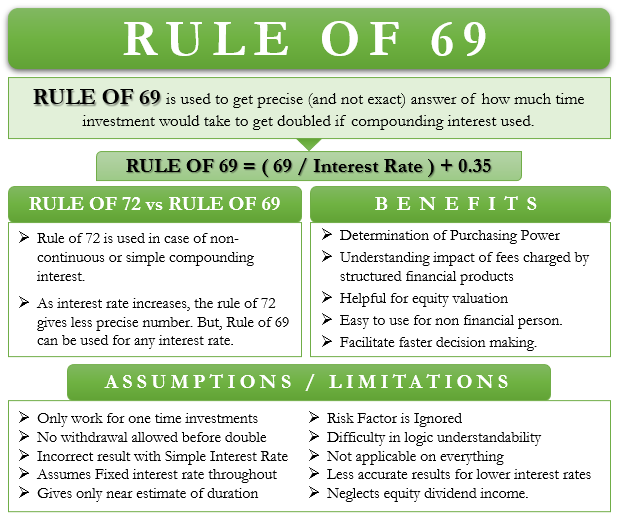
What is the Rule of 69?
The Rule of 69 is used to estimate the amount of time it will take for an investment to double, assuming continuously compounded interest. The calculation is to divide 69 by the rate of return for an investment and then add 0. 35 to the result. Doing so yields an approximately correct estimate of the time period required. For instance, an investor learns that he can get a 20% return on his property investment and wants to know how long it will take for his money to double. The calculation is:
(69 ÷ 20) + 0.35 = 3.8 years to double his money
Using the Rule means that a prospective investment can be easily analyzed with a calculator, rather than needing an electronic spreadsheet for a more precise return calculation.
Disadvantages of the Rule of 69
There are some good things about the Rule of 69, but there are also some bad things regarding it.
- Limited to continuous compounding. The Rule of 69 is only useful for investments that use continuous compounding, which doesn’t happen very often in real life. Most investments only compound interest once a year, three times a year, or once a month. This makes the rules less useful for figuring out how long it will take for an investment to double in most situations.
- Complexity compared to the Rule of 72. For discrete compounding intervals, the Rule of 72 is easier to use than the Rule of 69 because it is simpler and easier to understand. If an investor doesn’t have a strong background in math, the idea of continuous compounding can be hard to understand and use. Because of this, a lot of people like the Rule of 72 because it is simple to use and works just as well in most situations.
- Less accurate for low or high interest rates. The Rule of 69 is accurate when compounding interest is done over and over, but it is less accurate when interest rates are very low or very high. In these situations, the approximation may either overestimate or underestimate the real time it takes to double, which can lead to wrong conclusions. Because of this, it’s not as reliable as financial models with more details.
- Ignores real-world factors. The Rule of 69 doesn’t take into account real-world things like taxes, fees, inflation, or other things that can slow the growth of an investment. It oversimplifies the complicated process of long-term financial planning by focusing only on the interest rate. This can lead to too-high of hopes for how quickly investments will double.
- Challenging for non-finance professionals. Lots of people who aren’t good at math or finance may find it hard to understand the idea of continuous compounding and the math behind the Rule of 69. Because it’s so complicated, regular investors may not want to use it. They may find simpler rules, like the Rule of 72, easier to understand and follow.
These disadvantages highlight why the Rule of 69, despite its accuracy for continuous compounding, is less commonly used in practice compared to other rules for estimating doubling time.
