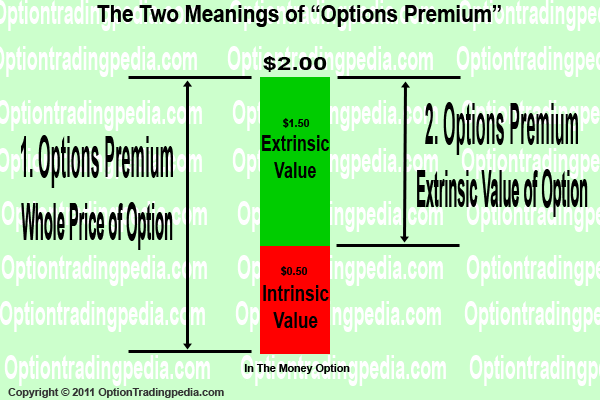
The “premium” is the price of an options contract in options trading. It includes both the intrinsic and extrinsic value of the contract.
In options trading, buyers pay the premium, while sellers receive it. This article will talk about what makes up option premiums, how they are calculated, and why they change over time.
Have you ever wondered what all that talk about “premium” means when people discuss options trading? If you’re scratching your head trying to figure out options terminology, you’re not alone! The concept of premium is actually pretty straightforward once you break it down, and it’s a crucial piece of the puzzle for anyone looking to dip their toes into options trading.
What Does Premium Mean in Options?
A buyer pays a seller (also known as a writer) for an options contract. This price is called the option premium. You can think of it as the cost or market price of buying that option. For the right, but not the obligation, to buy or sell an underlying asset at a certain price before a certain date, in options trading, we talk about premium. This is real money that changes hands.
This premium shows how much the options contract is worth on the market right now. It’s what keeps the options market going. The buyer pays this premium to get certain rights, and the seller gets this premium as payment for taking on certain obligations.
Breaking Down the Components of Option Premium
There isn’t just one random number that makes up the option premium. It’s made up of a few important parts that work together.
1. Intrinsic Value
This is the measurable, real value of the option if you were to exercise it immediately. For a call option, it’s calculated as
Intrinsic Value = Current Price of Underlying Asset - Strike Price (if positive, otherwise zero)For a put option, it’s:
Intrinsic Value = Strike Price - Current Price of Underlying Asset (if positive, otherwise zero)2. Extrinsic Value (Time Value)
This is the premium’s extra value over and above its intrinsic value. It takes into account both volatility and time value, which is the chance that the option will gain value before it expires.
Extrinsic Value = Option Premium - Intrinsic Value3. Implied Volatility Component
This reflects the market’s expectation of how volatile the underlying asset might be. Higher implied volatility = higher premiums.
So basically, Option Premium = Intrinsic Value + Time Value + Implied Volatility component.
Factors That Influence Option Premiums
Now that we know what makes up an option premium, let’s talk about what makes it go up or down. Several key factors influence how much you’ll pay (or receive) for an options contract:
1. Price of the Underlying Asset
As the price of the underlying stock or asset changes, so does the option premium. For call options, premiums typically increase when the underlying asset’s price rises. For put options, premiums typically increase when the underlying asset’s price falls.
2. Moneyness (In-the-Money vs. Out-of-the-Money)
- In-the-money options have intrinsic value and usually carry higher premiums
- At-the-money options have no intrinsic value but maximum time value
- Out-of-the-money options have no intrinsic value and rely solely on extrinsic value
The closer an option is to being in-the-money, the more expensive its premium tends to be.
3. Time Until Expiration
Options are like ice cubes on a hot day – they melt away as time passes! This phenomenon, known as time decay, means:
- Longer time until expiration = higher premium
- Shorter time until expiration = lower premium
Time decay accelerates as the expiration date approaches, which is why you’ll notice option premiums declining more rapidly in the final weeks before expiration.
4. Implied Volatility
This is arguably the trickiest but most powerful factor affecting option premiums. When market participants expect big price swings in the underlying asset, they’re willing to pay higher premiums for options. This makes sense when you think about it – the more volatile the asset, the greater chance the option has of becoming profitable before expiration.
If implied volatility increases from 20% to 50%, you’ll see option premiums rise significantly, even if the underlying price hasn’t moved much.
Real-World Example of Option Premium in Action
Let’s look at a simple example to make this concrete:
Imagine XYZ stock is trading at $50 per share, and you’re interested in a call option with a $45 strike price that expires in 30 days. The option premium is $7.
Breaking this down:
- Intrinsic value: $5 ($50 current price – $45 strike price)
- Extrinsic value: $2 ($7 premium – $5 intrinsic value)
Now let’s say implied volatility increases because of an upcoming earnings announcement. The premium might jump to $9 without the stock price changing at all. That $2 increase is purely from the higher implied volatility component.
Why Option Premiums Matter
Understanding option premiums isn’t just academic – it directly impacts your trading results:
For Option Buyers:
- The premium is your maximum possible loss
- It’s the upfront cost you pay for the right to control a larger position
- You need the underlying asset to move enough to overcome the premium paid
For Option Sellers (Writers):
- The premium is your maximum possible profit
- It provides immediate income
- It serves as compensation for taking on potentially unlimited risk (especially with naked calls)
Option Premium Strategies for Different Market Conditions
Depending on market conditions, different option strategies can leverage premiums in your favor:
High Volatility Markets
When premiums are inflated due to high volatility, selling options can be attractive:
- Covered Calls: Sell call options against stocks you already own to generate income
- Credit Spreads: Sell a more expensive option and buy a cheaper one to limit risk while collecting premium
Low Volatility Markets
When premiums are relatively cheap, buying options can make sense:
- Long Calls/Puts: Purchase options outright to speculate on directional moves
- Debit Spreads: Buy a more expensive option and sell a cheaper one to reduce cost
Common Mistakes When Dealing With Option Premiums
I’ve seen traders (myself included!) make these mistakes when dealing with option premiums:
- Ignoring implied volatility: Many new traders focus only on directional predictions and ignore how implied volatility affects premiums
- Underestimating time decay: The erosion of time value happens faster than most people expect
- Paying too much: Overpaying for options in high volatility environments without adjusting strategy
- Not accounting for all premium components: Failing to understand what portion of premium is intrinsic vs. extrinsic
Hedging Using Option Premiums
One of the most powerful applications of options is using their premiums for hedging strategies. Many investors and traders use options premiums as part of a comprehensive risk management approach:
- Portfolio Protection: Buying put options as insurance against market downturns
- Collaring Positions: Combining covered calls and protective puts to establish price ranges
- Delta Hedging: Advanced strategy that uses options premiums to neutralize directional exposure
The Bottom Line on Option Premiums
The premium in options trading is simply the price paid by the buyer to the seller of an options contract. It’s determined by intrinsic value, time value, and implied volatility, and it fluctuates based on changes in the underlying asset price, time to expiration, and market expectations of volatility.
For investors considering options trading, understanding how premiums work is absolutely essential. Whether you’re looking to generate income through writing options or seeking leveraged exposure through buying them, the premium is where the rubber meets the road in options trading.
Remember that options can be complex instruments, and premium pricing reflects that complexity. But with a solid grasp of what affects option premiums, you’ll be better equipped to spot opportunities and avoid pitfalls in your trading journey.
Final Thoughts
We’ve covered a lot about option premiums today! From understanding what they are and how they’re calculated to seeing how different factors influence their pricing, premium is truly the heart of options trading.
The next time you look at an options chain and see those premium prices, you’ll know there’s a whole world of factors behind those numbers. And hopefully, you’ll be able to use this knowledge to make more informed trading decisions.
Have you had any experience trading options? What aspects of option premiums do you find most challenging? I’d love to hear your thoughts and experiences in the comments below!
Remember: Every options trader was a beginner once. Understanding premium is just the first step on an exciting journey into the world of options trading.
Option Premium: Intrinsic Value Factors
Determining an options intrinsic value is easy; it is simply the amount by which the option is in-the-money (ITM).
Let’s say the price of a stock is $100 per share. All call options at or above this price will have no value because they are all out-of-the-money (OTM).
How Do You Calculate an Option Premium?
The price of any call or put option consists of summing together two components: intrinsic and extrinsic value.
- Intrinsic Value: The value of an option if it were to be used right away.
- All the other value of an option, like the time left until it expires and how volatile it is, is called extrinsic value. Â .

An option can have all extrinsic value, all intrinsic value, or a combination of each.Â
Next, we will take a closer look at each of these components.
Option Premium Example – A Simple Guide To Options Premium
FAQ
How does option premium work?
An option premium is the price paid by an option buyer to the seller for the right to buy or sell an underlying asset. This price is affected by the option’s intrinsic and extrinsic values, which are set by things like the time until expiration, the implied volatility, and the difference between the current price and the strike price.
What is an example of a premium option?
Option prices are charged per contract purchased, for example, an investor decides to buy a call option for a stock, at a strike of $50, the investor gets offered that call for a premium of $4. The investor decides to buy one contract, which controls 100 shares of the stock, the investor would pay $400 in total.
Who pays the premium for options?
An option premium is the price paid by the buyer of an options contract to the seller, reflecting the current market value.
Does premium mean profit?
If you’re wondering what is the premium on insurance, it’s the amount paid by policyholders in exchange for coverage. The goal for insurers is to invest these premiums in a way that makes more money than the amount they have to pay out in claims and benefits. This allows them to make a profit.
