Regional economic development officials offered incentives that attracted warehouses, manufacturing plants, and healthcare startups, reviving the economy and generating jobs. By 2018, hundreds of these deals over the previous eight years had created some 150,000 jobs.
Central Ohio now hopes to repeat that success. Its betting big on “Silicon Heartland,” a high-tech innovation hub that proponents hope will be flush with high-paying jobs. Economic officials have dangled multimillion-dollar tax subsidy packages before some of the worlds biggest technology companies.
The resulting investment, Gov. Mike DeWine promised, “further cements Ohio as the heart of our nations technology and innovation.”
Mostly, theyre getting data centers. Central Ohio has become one of Americas hottest hubs for these computing warehouses, with companies including Amazon, Google, Meta, and QTS flocking there, lured largely by generous incentives.
A Business Insider analysis of construction permits, economic development deals, and company disclosures found that even the largest data centers generally employ fewer than 150 permanent workers, and some have as few as 25. Building those data centers also creates significant numbers of construction jobs, but those are short term, sometimes lasting less than a year — far shorter than the duration of the tax breaks the companies get, which often last a decade or longer.
That means the tax breaks given to developers can amount over time to more than $2 million for every permanent, full-time job at an operational data center, Business Insiders analysis found. Thats roughly eight times higher than the $262,000 average per job that watchdog group Good Jobs First found in 18 economic development deals worth at least $50 million awarded in 2023.
The number of jobs doesnt balance the cost, multiple economists and researchers who study tax subsidies told Business Insider — even factoring in the construction and other supporting roles that the tech industry uses to calculate its economic impact. Records show that the workforce on data center projects quickly tapers off, meaning industry estimates often significantly overstate long-term employment benefits.
The costs to the public dont end with tax subsidies. Data centers drive up electricity costs for other ratepayers as utility operators invest billions of dollars in new grid infrastructure to support escalating power demands. That has drawn opposition from other companies including retail giant Walmart, which has said that surging electricity bills are imperiling its expansion in states such as Ohio and Virginia.
“Each new data center built in Ohio spurs a significant boost in investment, revenue, and wages that flow to Ohio businesses and workers, stimulating the states economy,” Josh Levi, the president of the Data Center Coalition, an industry advocacy group, wrote in an August 2024 op-ed article published by Cleveland.com. In recent US congressional testimony, he cited an estimate that data centers in Central Ohio supported more than “10,000 construction jobs, 2,000 data center jobs, and hundreds of maintenance and retrofitting jobs last year.”
In 2021, for example, Google entered into a much-celebrated deal with Columbus to construct a data center campus. The city offered a 100% property tax abatement worth an estimated $54 million in tax savings over 15 years.
In exchange, the Google facility promised 20 full-time jobs at the data center, rising to about 40 jobs by 2047.
Hey there fellow Corn Belt Energy members! Today I’m gonna share everything you need to know about paying your electricity bill with our local cooperative. As someone who’s been a member for years, I’ve tried pretty much all the payment methods they offer, and lemme tell you – they’ve really made it convenient these days!
Who Is Corn Belt Energy?
Before diving into bill payment options, let’s quickly cover who Corn Belt Energy actually is They’re a not-for-profit energy cooperative serving over 38,000 households and businesses across 18 counties. What’s cool is that we members actually own the cooperative! They’re governed by 11 directors who are also residential members themselves
The cooperative has been around since 1938 and focuses on providing reliable, affordable energy while supporting energy efficiency, education, and safety initiatives.
Why Choose Automatic Bill Payment?
Listen, life gets busy. Between work, family, and everything else, it’s easy to forget to pay bills on time That’s why I switched to Corn Belt Energy’s Autopay option, and honestly, I haven’t looked back!
Benefits of Autopay:
- Never miss a payment – no more late fees!
- Save time each month
- Simple setup process
- Choose your payment method (checking/savings or credit/debit card)
- Get a $20 bill credit when you combine it with paperless billing!
How to Set Up Autopay with Corn Belt Energy
Setting up automatic payments is pretty straightforward. Here’s how:
- Log into your SmartHub account at cornbeltenergy.smarthub.coop
- Navigate to the Billing section
- Select “Auto Pay Program”
- Choose your preferred payment method:
- Checking/savings account
- Credit/debit card
- Enter your payment information
- Set your preferred withdrawal date
- Confirm and submit!
Once set up, your bill will be automatically paid each month – no more writing checks or remembering due dates!
Paperless Billing: Save Trees & Get Rewards
Another great option that Corn Belt Energy offers is paperless billing. I switched to this about 2 years ago, and it’s been great! Instead of getting a paper bill in the mail, you’ll receive an email notification when your new bill is ready to view.
Why Go Paperless?
- Reduce paper waste and help the environment
- Reduce mailbox clutter – one less thing to sort through!
- View your bill anytime from your computer or smartphone
- Faster access to your bill information
- Get a $20 credit when you combine with Autopay!
How to Sign Up for Paperless Billing:
- Log into your SmartHub account
- Go to “My Profile”
- Select “Update My Paperless Settings”
- Check the box to go paperless
- Save your changes
Remember, if you sign up for BOTH Autopay AND Paperless Billing, you’ll receive a one-time $20 bill credit! That’s like getting a free partial payment just for making your life easier.
SmartHub: Your 24/7 Account Management Tool
One of the best ways to manage your Corn Belt Energy account is through SmartHub. It’s available 24/7 and gives you complete control over your account.
What Can You Do with SmartHub?
- View and pay your bill
- Set up automatic payments
- Sign up for paperless billing
- View your energy usage
- Report outages
- Contact customer service
SmartHub can be accessed via web browser at cornbeltenergy.smarthub.coop or through their mobile app.
Other Payment Methods
While Autopay and SmartHub are super convenient, Corn Belt Energy understands that members have different preferences. Here are the other ways you can pay your bill:
Online One-Time Payment
If you don’t want to set up Autopay but still want to pay online, you can make one-time payments through SmartHub. This is perfect for those who like to review their bill before paying each month.
By Phone
You can call Corn Belt Energy at 309-662-5330 during office hours (Monday through Friday, 8:00 a.m. to 4:30 p.m.) to make a payment over the phone.
By Mail
Old school but reliable! You can mail your payment to:
Corn Belt Energy1 Energy WayBloomington, IL 61705In Person
You can also pay in person at their office during business hours. The address is the same as the mailing address above.
Prepaid Electric Service
Did you know Corn Belt Energy also offers prepaid electric service? This pay-as-you-go option lets you put money on your account in advance and then uses it as you consume electricity.
Benefits of Prepaid Service:
- No security deposits required
- No late fees ever
- Pay when it works for your budget
- Monitor your usage more closely
- Helps many members reduce consumption by being more aware
I know a couple families who’ve switched to prepaid and they say it’s really helped them budget better for their energy costs.
Understanding Your Corn Belt Energy Bill
Sometimes the hardest part isn’t paying the bill, but understanding what you’re paying for! Let me break down the typical Corn Belt Energy bill for ya:
Key Components of Your Bill:
- Service Charges: Basic fee for being connected to the grid
- Energy Charges: What you pay per kilowatt-hour (kWh) used
- Power Cost Adjustment: Fluctuates based on the actual cost of generating power
- Taxes: Various state and local taxes
- Capital Credits: Your ownership stake in the cooperative
Speaking of Capital Credits – did you know Corn Belt Energy announced at their 86th Annual Meeting that they’re returning $10 million in Capital Credits to members in Summer 2024? That’s one of the perks of being part of a cooperative!
Energy Efficiency Programs to Lower Your Bill
Paying your bill is important, but so is reducing how much you owe in the first place! Corn Belt Energy offers several programs to help lower your energy consumption:
Rebate Programs
The cooperative offers various rebates for energy-efficient appliances and improvements. Check their website for current offerings.
Rate 11 / Load Control Program
By allowing Corn Belt Energy to control certain appliances during peak demand periods, you can qualify for lower rates.
Energy Saving Tips
Corn Belt Energy provides tons of advice on reducing energy usage. One tip I recently learned from their social media is that using small appliances like slow cookers, toaster ovens and air fryers uses less energy than your oven – perfect for fall recipes!
GeoCents Program
If you’re considering geothermal heating and cooling, their GeoCents program makes it more affordable. Corn Belt Energy will pay to have the geothermal loops installed in your yard, and you pay a monthly fee to use them.
What to Do If You Can’t Pay Your Bill
Life happens, and sometimes finances get tight. If you’re struggling to pay your bill, don’t just ignore it! Corn Belt Energy offers payment assistance options.
Steps to Take:
- Contact them early – call 309-662-5330 before your bill is due
- Ask about payment arrangements – they may be able to work out a plan
- Inquire about assistance programs – they can direct you to resources
- Consider switching to prepaid – might help with budgeting
Staying Connected with Corn Belt Energy
To stay up-to-date on billing options, outages, and energy-saving tips, follow Corn Belt Energy on social media:
- X (formerly Twitter)
They regularly post useful information, like recent scam alerts to keep members safe!
Final Thoughts
Managing your Corn Belt Energy bill doesn’t have to be complicated! With options like Autopay, paperless billing, and SmartHub, you can choose what works best for your lifestyle.
As a member of this cooperative, I appreciate how they’ve modernized their payment systems while still maintaining the personal touch of a community-focused organization. Plus, that $20 credit for signing up for both Autopay and paperless billing is a nice little bonus!
Have you tried any of these payment methods? Which one works best for you? I’d love to hear your experiences in the comments below!
Remember, Corn Belt Energy is an equal opportunity provider and employer serving our community since 1938. If you have any questions about your bill or payment options, don’t hesitate to contact them at 309-662-5330 or visit their office at 1 Energy Way, Bloomington, IL 61705 during business hours.
Stay warm and energy-efficient this fall!
Pricing the ‘Silicon Heartland’
Artificial intelligence is accelerating data center construction that already was growing quickly to power digital services from social media to medical care. In 2025 alone, Meta plans to spend at least $64 billion on facilities and equipment. Googles parent company, Alphabet, plans to spend $75 billion, and Microsoft said it would invest $80 billion.
Tech companies say their investments will supercharge local tax revenues and high-paying jobs will drive economic growth. Even with tax breaks, data centers contributed $162.7 billion in federal, state, and local tax revenue in 2023, according to a February 2025 PwC report prepared for the Data Center Coalition. The industry, the report said, supported 4.7 million jobs directly at data centers or indirectly through their supply chain.
Amazon, the biggest data center operator, calculates that its data centers each year have supported thousands of jobs, including 6,490 in Ohio and 20,700 in Virginia. Matt Hurst, a spokesperson for Amazon Web Services, Amazons cloud-computing arm, told Business Insider the company was “proud of the good jobs we create, for the trust local communities invest in us, and for the opportunity we have to invest in those communities.”
Meta says that its data center operations support 16,000 jobs and $1.2 billion in labor income annually, and that it has backed 440,000 construction jobs over the past decade. Google says its data centers supported 119,000 jobs and contributed $12.6 billion to US gross domestic product in 2023 across its supply chain, including construction. Microsofts website says its data centers generate “public infrastructure improvements and tax revenue that serve as a catalyst for enhancing the quality of life.”
“Our developments generate millions of dollars in tax revenue to support local priorities related to schools, roads, housing, and other critical needs, while also reducing the tax burden on residents,” a spokesperson for QTS, which is owned by the investment firm Blackstone, said in a statement.
A Blackstone spokesperson also highlighted the benefits of data center development and said the company was “proud that our investment in QTS provides the digital infrastructure critical to the future of our country and economy.”
Competition to score these promised benefits can be a race to the bottom, as developers pit state against state and city against city. New projects cluster in areas that offer the most competitive deals.
To investigate how these incentive deals play out, Business Insider identified areas of data center development and filed requests with all 50 states and Washington, DC, for the air permits that regulate backup generators at every data center. Business Insider compiled records for 1,240 data centers nationwide, the most definitive accounting to date, and requested records of data-center-related economic incentives from municipalities and states.
The largest data centers in Business Insiders analysis — the 322 massive facilities that we estimate consume 40 megawatts of electricity or more each — are heavily concentrated in a few places. Northern Virginia has 214, followed by Arizonas Maricopa County with 16, and Ohios Columbus region with 9.
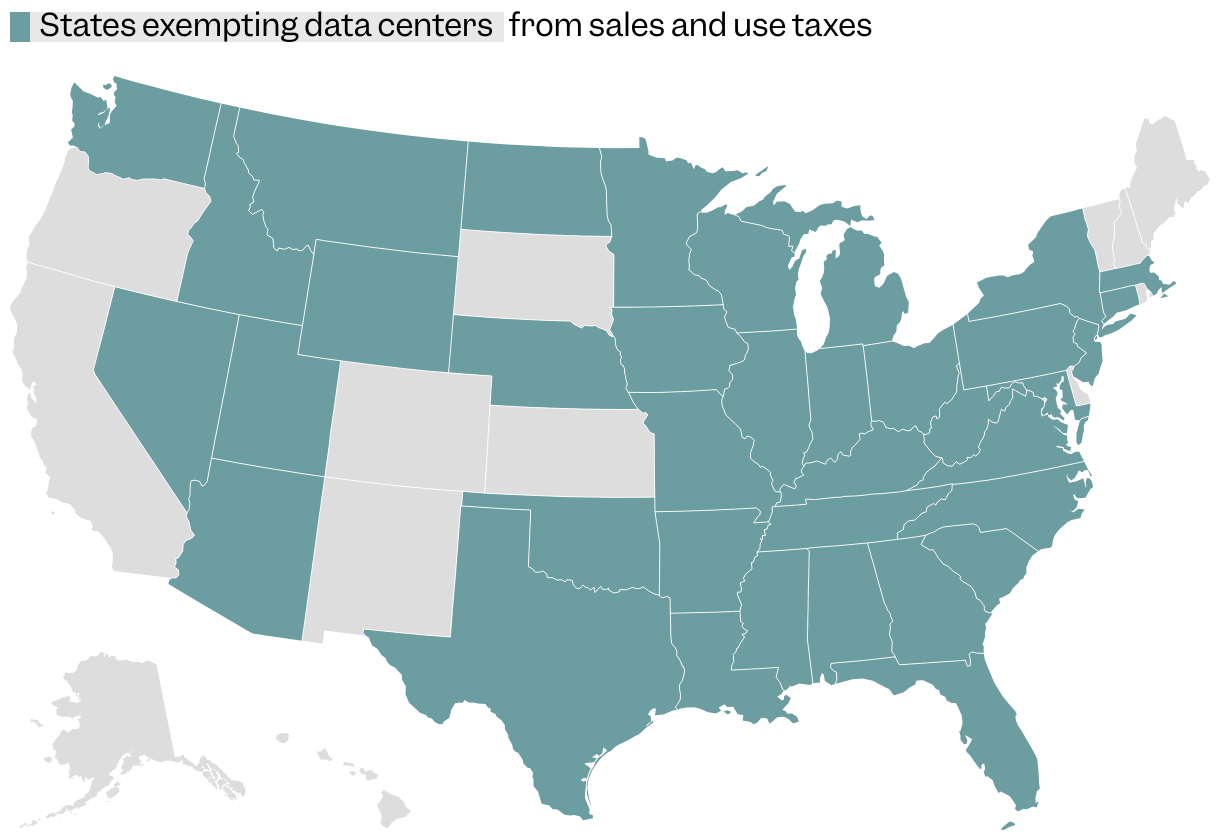
Thirty-seven states have tax incentive programs for data center investments. Most exempt developers from sales and use taxes on building materials, machinery, or equipment — resulting in big hits to state coffers. In Virginia, 56 data center projects cost $928 million in abated state sales tax in the 2023 fiscal year alone. Disclosures in Ohio estimate it forfeited nearly $360 million in data-center-related state tax revenue from the 2022 through 2024 fiscal years.
Mason Waldvogel, a spokesperson for the Ohio Department of Development, called the tax incentive program “a strategic tool used to create long-term economic growth by attracting high-value, capital-intensive projects.” A spokesperson for the Data Center Coalition said state tax exemptions for data centers were consistent with programs for other capital-intensive industries.
Cities also offer incentives, including breaks on property taxes and reimbursements for building fees. Arizona cities largely dont give property tax abatements but allow the use of precious water resources. Virginia grants access to enormous amounts of electricity and critical infrastructure but requires data centers to pay local property taxes. Indeed, Northern Virginia cities generate up to 31% of their total tax revenue from data centers, funding fire departments, affordable housing, and other services.
In the Columbus region, Business Insider located 19 data center-related deals that, together with state-level abatements, amounted to at least $750 million in forfeited tax revenue for 770 full-time jobs employed at data centers as of December 2023.
The jobs generally pay well, averaging $100,000 a year in Central Ohio, according to company disclosures. At the Google data center in Columbus, salaries range from $74,000 for a data center technician to $162,000 for an operations manager.
Amazon tops the list with seven deals. In one, the northwest Columbus suburb of Dublin agreed to sell Amazon 66 acres, which the city valued at $100,000 an acre, for $1 in total. Amazon agreed to pay the farmers previously leasing the land up to $40,000 total to abandon their soybeans and corn crops and terminate the lease. It told Dublin it expected to hire 25 full-time workers by the end of 2018, a nonbinding projection. In contrast, Amazon projected that it would hire 1,000 Ohioans at a new fulfillment center in Canton several years later — without taking any local property tax abatements or state incentives.
Amazons Hurst said the company works hard to create every job it projects.
The deals keep coming, from Batavia, New York, to Meridian, Mississippi.
Business Insider tells the innovative stories you want to know
Nathan M. Jensen, a professor at the University of Texas at Austin who studies regional tax incentive programs, said cities are better off sitting these deals out. Communities throw everything they can at tech companies, yet when the costs of lost tax revenue and escalating electricity prices are factored against what the communities get back in jobs, revenue, and prestige, “theres just no evidence that youre going to benefit from that data center,” he said.
If data center developers threaten to walk from cities that refuse to compete for these deals, Jensens advice is blunt: “Let em walk.”
Jensen said data centers were shaping up like professional sports stadiums, where cities give millions in tax revenue savings in exchange for temporary construction jobs and minimal economic impact. Construction of data centers generally lasts one to two years, or sometimes longer, and many construction jobs run for only part of that period.
In Virginia, one analysis found that about 80% of jobs from data centers created over a recent two-year period were in construction. And the numbers of such data-center-supported jobs cited in this years Data Center Coalition report may be misleading, multiple economists and researchers who study incentives told Business Insider.
Timothy Bartik, a senior economist at the W.E. Upjohn Institute for Employment Research, a not-for-profit organization focused on reducing unemployment, said his own study suggests job numbers in the high-tech sector, like data centers, could be less than half of industry estimates.
Microsoft estimated last year that a campus with six data centers that it is building outside Cheyenne, Wyoming, would have 1,005 jobs at peak construction, falling to 335 full-time employees and contractors by the end of next year.
At a construction project in Columbus for the data center operator Cologix, one contractor, Baker Concrete Construction, had 63 people on payroll. Those jobs lasted an average of 6 ½ weeks. Cologix said that overall the site had an average of 146 workers during the projects construction.
Incentive packages often spell out how many jobs a company commits to creating in exchange for its tax breaks. Data center companies generally commit to deliver only the jobs inside their facilities in exchange for their tax breaks — not the construction and other ancillary jobs they say their projects create. Based on what is actually promised in such deals, those jobs can be expensive for local governments. Business Insider identified five deals in Ohio where, as of December 2023, each long-term job in the data centers cost over $1 million in abated taxes over the life of the deal.
An Amazon data center in Hilliard had saved at least $195 million in state and local taxes as of December 2023, according to annual disclosures, driving the price of each job to over $1 million in abated taxes. New Albany, Ohio, garnered 98 jobs at a Meta data center, but forfeited $189.6 million in state and local taxes as of the end of 2023 — making each job worth about $1.9 million in foregone tax revenue.
“We disagree with this way of thinking about the benefits we bring to communities,” Amazons Hurst said, adding that it benefits communities in ways beyond direct job creation, such as spending with local businesses and funding job-training efforts. A Meta spokesperson said it helps communities where it operates through grants and partnerships.
The Data Center Coalition spokesperson said that focusing on jobs inside data centers understates the impact on service providers and suppliers, such as electricians, HVAC manufacturers, and portable sanitation companies.
Companies are still required to make yearly payments to the cities in lieu of property taxes to help ensure minimum contributions to the communities, which Business Insider incorporated into our cost-per-job calculations. Meta, for example, paid $21.8 million in total to New Albany as of December 2022. A spokesperson for New Albany said the payments ensure “data centers contribute meaningfully to the community, even with tax abatements in place.”
And tech companies often sweeten the deals by promising to invest in education programs to upskill local workers. Amazon, for example, donated $25,000 and some equipment two years ago to the Tolles Career & Technical Center in Plain City, Ohio, to support the schools IT and cybersecurity training programs, which include a four-week training program for entry-level data center workers. At the nearby Columbus State Community College, the company pledged $50,000 in scholarships for a new data center technician certificate program.
The ultrapowerful computer chips crammed into data centers consume enormous amounts of power. A 2024 Department of Energy report estimates their electricity use, driven by the AI boom, could soon command as much as 12% of total US electricity use, from just over 4% in 2023.
Data centers are getting breaks on that, too — which residents and other businesses are helping pay for.
From 2020 through last year, Ohio data centers load on the grid rose sixfold. By 2030, American Electric Power Ohio, the states largest electricity provider, expects to grow by another 700% to reach 5,000 megawatts, enough to power at least 2 million homes.
If all hookup requests across more than 90 planned data center sites in Ohio are approved, AEP Ohio told regulators, demand could skyrocket to over 30,000 megawatts.
emPOWER: Winter Heating Tips
FAQ
How do I pay my Corn Belt energy bill?
Member is responsible for the cost of postage. Make your payment at a location near your home or work. No bank account needed. Many locations are available throughout the Corn Belt Energy service territory. Sign up online for SmartHub.* SmartHub is offered online or as the SmartHub app on your Apple or Android phone.
Does Corn Belt energy offer autopay?
Corn Belt Energy offers Autopay. Members have the opportunity to have their monthly electric bill payment automatically deducted from their checking/savings account or a debit/credit card. In addition, reduce your monthly paper usage and mailbox clutter by signing up for Paperless Billing. BONUS!
Does Corn Belt energy pay for geothermal loops?
Corn Belt Energy will pay to have the geothermal loops (the outside loops that go into your yard) installed at your home. In turn, you will pay a monthly fee to be able to utilize the loops. Corn Belt Energy is owned by the members who use our services as a not-for-profit electric cooperative.
Will Corn Belt energy return $10 million in capital credits in summer 2024?
During the 86th Annual Meeting, it was formally announced that Corn Belt Energy will return $10 million in Capital Credits in Summer 2024. Corn Belt Energy offices will be closed Monday, May 26th in observance of Memorial Day. Should you experience a power outage during this time, please report the outage via SmartHub or call us at 309-662-5330.
How do I pay my electric bill?
We offer several ways for you to pay your electric bill from in person to paperless. View the chart below for more information on the different ways you can pay. Set up AutoPay through SmartHub online or over the phone.* Member is responsible for the cost of postage. Make your payment at a location near your home or work. No bank account needed.
