Donald Trumps hush money trial is underway in New York, and the historic case is drawing attention to past incidents of high-profile litigation involving political stars and allegations of salacious affairs.
Trump is facing felony charges related to a payment made to adult film actress Stormy Daniels in the weeks before the 2016 presidential election. The former president denies any wrongdoing.
Some have compared Trumps case to the prosecution of John Edwards, a former Democratic senator who was indicted for an alleged plot to conceal an extramarital relationship and child during his 2008 presidential run.
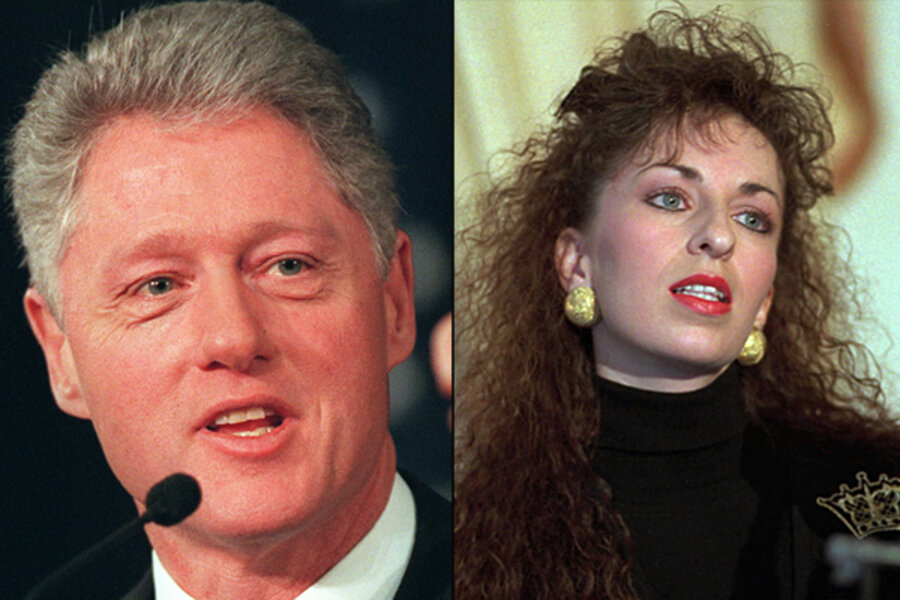
Others have tried to draw a comparison with it former President Bill Clintons settlement with Paula Jones in 1998 to end a yearslong sexual harassment lawsuit.
Have you ever heard people say that Bill Clinton paid “hush money” to Paula Jones? This claim has been floating around social media for years, especially when comparisons are made to other political figures But what’s the real story behind that $850,000 payment? Let’s dig into the facts and clear up some misconceptions
What Actually Happened Between Clinton and Jones?
In May 1994, Paula Jones filed a sexual harassment lawsuit against then-President Bill Clinton She alleged that in 1991, when Clinton was Governor of Arkansas, he propositioned her, exposed himself, and touched her without consent in a hotel room during a conference in Little Rock
The story first gained public attention in January 1994 when The American Spectator magazine published an article that included an account from a state trooper who brought a woman – identified only as “Paula” – to Clinton’s hotel room. After this publication Jones went public with her identity and filed the lawsuit.
The timeline goes something like this:
- May 8, 1991: Alleged incident occurs in Little Rock hotel room
- January 1994: American Spectator publishes story with details of the encounter
- May 1994: Jones files sexual harassment lawsuit against Clinton
- November 1998: Clinton settles the lawsuit with Jones
- January 1999: Clinton pays Jones $850,000 as part of settlement agreement
Was It Really “Hush Money”?
Here’s where things get interesting. Many social media posts and commentators have labeled this payment as “hush money,” but legal experts disagree with this characterization.
According to multiple legal experts quoted in USA Today’s fact-check article:
“Clinton paying money to settle a publicly filed lawsuit and Trump paying money to keep Daniels quiet are two very different things,” said Neama Rahmani, a former federal prosecutor.
David Weinstein, a former assistant U.S. attorney, explains that “hush money” specifically describes a payment made to prevent someone from revealing details about something. In Clinton’s case, the lawsuit was already filed and the allegations were public knowledge before the payment was made.
Jerry Goldfeder, an election and campaign finance law expert, puts it simply: “Hush money is to keep someone quiet, thus the name. Paying someone to settle a lawsuit in public is not.”
The Settlement Details
When Clinton settled with Jones in November 1998, he did not admit to any wrongdoing. The $850,000 payment was made in January 1999 as part of the settlement agreement.
Interestingly, The New York Times reported that $475,000 of the settlement came from Clinton’s insurance policy against civil liability with Chubb Group Insurance. Most, if not all, of the remainder came from then-first lady Hillary Clinton’s blind trust. Of the total amount, Jones kept $200,000, and the rest went to her lawyers.
Key Differences from Other Political Payment Cases
There are several important distinctions between Clinton’s settlement and what some might consider actual “hush money” payments:
-
Public Knowledge vs. Secrecy: Jones’ allegations were already public when the settlement occurred. There was no attempt to keep the matter secret.
-
Timing Relative to Elections: As Bradley Moss, a national security lawyer, noted, Clinton’s payment was made “deep into Clinton’s second term in office and irrespective of the 2000 campaign – in which Clinton was not a candidate.”
-
No Non-Disclosure Agreement: Unlike some other high-profile cases, Jones’ settlement wasn’t contingent on her silence about the allegations.
-
Legal Context: The payment resolved an existing, public lawsuit rather than preemptively preventing information from becoming public.
Why This Matters
The distinction between a settlement payment and “hush money” isn’t just semantic – it has legal implications. Settlement payments to resolve lawsuits are common and legal. They don’t necessarily imply guilt, but rather can be practical decisions to avoid prolonged litigation.
On the other hand, payments specifically designed to prevent information from becoming public, especially when timed to influence elections or otherwise violate campaign finance laws, can potentially cross into illegal territory.
Common Misconceptions
Let’s address some frequent misunderstandings about this case:
Misconception 1: Clinton paid Jones to keep quiet about their encounter.
Reality: The payment was part of a settlement agreement for a lawsuit where the allegations were already public.
Misconception 2: The payment proves Clinton’s guilt.
Reality: Settlement agreements frequently include provisions stating that payment doesn’t constitute admission of wrongdoing.
Misconception 3: This case is directly comparable to other political “hush money” cases.
Reality: Legal experts point to significant differences in timing, disclosure, and purpose.
The Aftermath and Legacy
The Jones lawsuit had far-reaching consequences beyond the settlement itself. During the discovery phase of the Jones case, Clinton was questioned about his relationship with Monica Lewinsky, a White House intern. His denial of this relationship under oath ultimately led to his impeachment by the House of Representatives on charges of perjury and obstruction of justice (though he was acquitted by the Senate).
The case also highlighted issues around sexual harassment allegations against powerful figures and sparked debates about the privacy of public officials that continue to this day.
How Media Covered the Story
Media coverage of the settlement varied widely. Some outlets framed it as Clinton finally being held accountable, while others portrayed it as a pragmatic end to a politically motivated lawsuit. The settlement received extensive coverage, but the characterization of the payment as “hush money” wasn’t common in mainstream reporting at the time.
It’s worth noting that in more recent years, social media has seen an increase in posts incorrectly labeling the payment as “hush money,” often in attempts to draw equivalence with other political cases.
Legal Experts Weigh In
Additional legal experts beyond those already mentioned have consistently reinforced the distinction between Clinton’s settlement and “hush money.”
Bradley Moss, a partner at the Mark S. Zaid law firm and contributor to Lawfare, told Check Your Fact that Clinton’s payment to Jones is not “remotely similar or analogous” to certain other political payment cases. “There is nothing in the law or as a matter of strict fact that brings the $850,000 settlement payment in line with [other] hush money payment[s],” he said.
The Bottom Line
So did Bill Clinton pay Paula Jones $850k? Yes, he absolutely did make that payment. But was it “hush money” as some claim? According to legal experts and the factual timeline, no. It was a settlement payment to resolve a lawsuit where the allegations were already public knowledge.
Understanding these distinctions helps us better evaluate claims about political figures and avoid false equivalencies. While the payment itself is a matter of historical record, its characterization requires context and precision.
References
The information in this article comes from fact-checks published by USA Today and Check Your Fact, as well as historical reporting from The Washington Post and other news outlets. These sources have verified that Clinton’s payment to Jones was part of a lawsuit settlement, not “hush money” intended to keep her silent about their encounter.
Donald Trump’s New York trial
Manhattan District Attorney Alvin Bragg brought a 34-count indictment against Trump in April 2023, alleging he falsified business documents to hide damaging information from coming out during the 2016 campaign.
The allegedly falsified business records, Bragg said, were meant to hide a $130,000 payment Trumps then-attorney Michael Cohen made to Daniels to prevent her from going public with an allegation of a 2006 sexual encounter with Trump — an allegation he has long denied. Cohen pleaded guilty to campaign finance violations and other crimes, including lying to Congress, for his role in orchestrating the payment to Daniels.
At trial, prosecutors raised payments to other accusers — not part of the criminal charges — which were also meant to keep negative stories about Trump from becoming public. Other examples, Bragg said, were America Media Inc. payments to another women who alleged to have had a sexual relationship with Trump and to a doorman who peddled a false story about a child Trump allegedly had out of wedlock. David Pecker, former executive for AMI, testified about a so-called “catch and kill” scheme to bury negative news stories about Trump during the 2016 cycle.
Trump pleaded not guilty to all charges, and claims the legal proceeding is “election interference.”

Falsifying business records is a misdemeanor, but if it is done in furtherance of another crime, it becomes a felony.
Bragg did not specify in the indictment what the other crime was, but later highlighted several laws he said were potentially applicable, including New York state election law that prohibits conspiracies to promote a candidacy by unlawful means; laws that prohibit false statements, including statements that were planned to be made to tax authorities; and federal election contribution limits.
“This was a planned, coordinated, long-running conspiracy to influence the 2016 election, to help Donald Trump get elected through illegal expenditures, to silence people who had something bad about his behavior,” prosecutor Matthew Colangelo argued in court. “It was election fraud, pure and simple.”
John Edwards’ federal trial
In 2011, Edwards, a Democrat, was charged with campaign finance violations for allegedly soliciting nearly $1 million from wealthy donors to hide his affair with videographer Rielle Hunter (and that he was the father of their baby) to maintain his as a “family man” during his White House bid.
Edwards argued the donations were personal gifts from friends, not campaign contributions, and were intended to hide the affair from his wife who was battling deadly cancer, not from voters. He won acquittal on one count of receiving illegal campaign donations, and a mistrial on five other charges.

Experts previously noted the similarities between the Edwards case and the Trump case. Both involve payments to women to keep quiet about an alleged affair.
The two cases also similarly question whether the hush money payments were being used for campaign purposes or for personal reasons. Trumps team, like Edwards, has said the payment to Daniels was to spare his family embarrassment rather than influence the election.
Though there are notable differences in the two cases, including the timeline of payments. Hunter received money over an extended period of time, including after Edwards suspended his campaign, while a one-time payment was made to Daniels just ahead of Election Day.
William Jefferson Clinton v. Paula Corbin Jones Case Brief Summary | Law Case Explained
0
