The Post-9/11 GI Bill (PGIB), or Chapter 33, helps you pay for school or cover expenses while you’re training for a job. If you’ve served on active duty after September 10, 2001, you may qualify for the Post-9/11 GI Bill. Find out if you can get this education benefit.
Hey there, fellow veterans! Today I wanna talk about something that’s probably on your mind if you’re thinking about going back to school does the GI Bill pay for housing? The short answer is YES – but there’s more to it than just a simple yes or no Trust me, I’ve been there, navigating the VA benefit maze can be confusing!
As someone who’s helped many vets maximize their benefits, I’m gonna break this down for you in plain english. By the end of this article, you’ll understand exactly how the Post-9/11 GI Bill housing allowance works and how to get the most money possible for your situation.
What Housing Benefits Come With The Post-9/11 GI Bill?
The Post-9/11 GI Bill (Chapter 33) includes a Monthly Housing Allowance (MHA) that helps veterans pay for their living expenses while attending school or training. This is one of the most valuable parts of the benefit!
However, the VA won’t just hand you a check and say “good luck!” The amount you receive depends on several factors:
- Your eligibility tier (based on service time)
- Your rate of pursuit (how many credits you’re taking)
- Where you physically attend classes
- Whether you’re taking online or in-person classes
- Your active duty status
Let’s dig into the details of how this all works for the 2025-2026 academic year.
Who Qualifies for 100% of GI Bill Housing Benefits?
Not everyone gets the full housing benefit. Your eligibility percentage depends on your service time. To get 100% of the benefit, you need to meet at least ONE of these requirements:
- Served on active duty for at least 36 months (1,095 days)
- Received a Purple Heart on or after September 11, 2001
- Discharged due to a service-connected disability after serving at least 30 continuous days
If you served less time you’ll receive a percentage of the full benefit based on this tiered system
| Service Time | Eligibility Percentage |
|---|---|
| 30-35 months | 90% |
| 24-29 months | 80% |
| 18-23 months | 70% |
| 6-17 months | 60% |
| 3-5 months | 50% |
For example if you served 26 months and the full housing allowance for your area is $2000, you’d get 80% of that, or $1,600 per month.
How Much Will You Get For Housing?
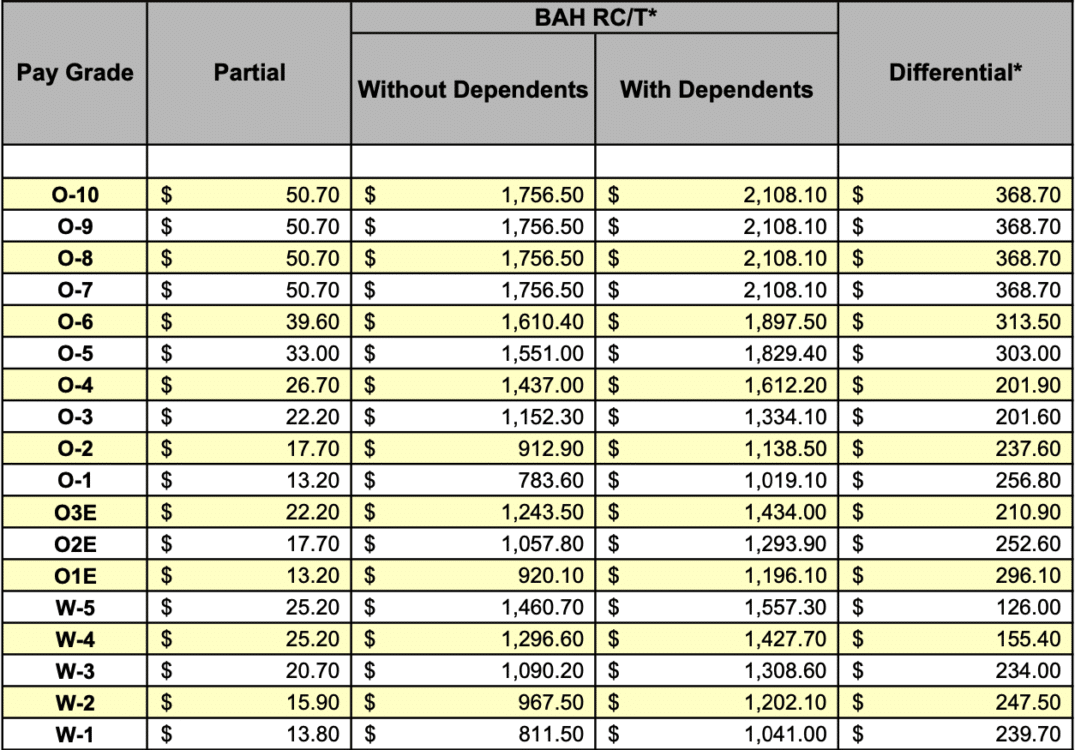
This is where things get interesting! The VA calculates your housing allowance based on the Defense Department’s Basic Allowance for Housing (BAH) rates for an E-5 with dependents in the zip code where your school is located.
For the period from August 1, 2025, to July 31, 2026, here’s how it breaks down:
For In-Person Courses in the U.S.
The amount varies widely depending on where you go to school. The VA uses the zip code of your campus to determine your rate. For example, attending school in San Francisco will get you a much higher MHA than attending in rural Iowa.
You can look up the specific BAH rate for your school’s zip code on the Defense Travel Management Office website.
For Online-Only Courses
If you’re taking only online classes, the housing allowance is set at half the national average. For the 2025-2026 academic year, that’s up to $1,169.00 per month.
Pro tip: If you take just ONE class in-person and the rest online, you can qualify for the higher in-person rate based on your school’s zip code! This could mean hundreds more dollars in your pocket each month.
For Foreign Schools
If you’re studying at a foreign institution, your housing allowance is based on the national average MHA. For 2025-2026, that’s up to $2,338.00 per month.
When You WON’T Get Housing Money
There are some situations where you won’t receive any housing allowance, even if you’re eligible for the GI Bill:
- You’re currently on active duty
- You’re a spouse using transferred benefits while the Veteran is on active duty
- You’re enrolled half-time or less
- You’re taking correspondence training or flight training only
- You’re on break from school
Other Factors That Affect Your Housing Payment
Rate of Pursuit
Your “rate of pursuit” refers to how many credits you’re taking compared to what your school considers full-time. To receive any housing allowance, your rate of pursuit must be more than 50%.
For example, if 12 credits is full-time at your school and you’re taking 9 credits, your rate of pursuit is 75% (9 ÷ 12 = 0.75).
The housing allowance is prorated based on this percentage. So if you’re eligible for $2,000 per month at 100% rate of pursuit but you’re only at 75%, you’d receive $1,500.
Location Matters!
The physical location where you attend most of your classes determines your housing rate. This is known as “location-based housing allowance.”
If you attend classes at different campuses, the VA will use the zip code of the campus where you take the majority of your classes.
Bonus Benefits Beyond Housing
While we’re focused on housing here, the Post-9/11 GI Bill offers other financial benefits worth mentioning:
Books and Supplies Stipend
You can receive up to $1,000 each academic year for books and supplies. For college students, that’s up to $41.67 per credit hour (for up to 24 credits per year). Non-college programs provide up to $83 per month.
This is prorated based on your eligibility percentage. For example, if you’re at 80% eligibility, you’d get 80% of these amounts.
Rural Relocation Assistance
If you need to move from a rural area to attend school, you might qualify for a one-time payment of $500 to help with moving expenses. To qualify:
- You must live in a county with 6 or fewer people per square mile (based on the latest census)
- AND you must need to relocate at least 500 miles away OR need to travel by air because ground transportation isn’t an option
On-the-Job Training and Apprenticeships
The GI Bill housing allowance works differently if you’re doing on-the-job training or an apprenticeship. Your monthly payment decreases as you progress through your program:
- Months 1-6: 100% of the applicable BAH rate
- Months 7-12: 80%
- Months 13-18: 60%
- Months 19-24: 40%
- After 2 years: 20%
This reduction reflects the assumption that as you gain more skills, your employer will be paying you more.
Tips to Maximize Your Housing Allowance
-
Choose your school location strategically: BAH rates vary significantly by location. If you have the flexibility to choose between schools, consider the housing allowance in each area.
-
Take at least one in-person class: If you’re primarily an online student, taking just one in-person class can dramatically increase your housing allowance.
-
Maintain more than half-time enrollment: Remember, you must be enrolled more than half-time to receive any housing allowance.
-
Check your eligibility tier: Make sure the VA has correctly calculated your service time to determine your eligibility percentage.
-
Apply for Yellow Ribbon if tuition exceeds the cap: While not directly related to housing, the Yellow Ribbon Program can help cover tuition costs that exceed the GI Bill cap, freeing up more of your own money for housing.
When and How You’ll Receive Your Housing Payments
The VA pays housing allowances at the end of each month for the previous month’s attendance. For example, you’ll receive September’s payment in early October.
Payments are typically made by direct deposit to the bank account you have on file with the VA. It’s super important to make sure your banking information is up to date!
What If You Have Questions About Your Housing Benefits?
If you have questions or issues with your GI Bill housing allowance, you can:
- Contact the VA at 888-442-4551 (TTY: 711), Monday through Friday, 8:00 a.m. to 7:00 p.m. ET
- Use the online “Ask VA” feature on their website
- Speak with your school’s Veterans Affairs office, which can often help resolve issues
Final Thoughts
The Post-9/11 GI Bill housing allowance is an amazing benefit that can make going back to school much more financially feasible. But as you can see, it’s not a one-size-fits-all program. Your specific benefit depends on multiple factors, and understanding these can help you maximize what you receive.
Have you used your GI Bill housing allowance yet? I’d love to hear about your experience in the comments below! And if you found this article helpful, please share it with other veterans who might benefit from this information.
Stay tuned for more articles where we’ll dig into other aspects of veteran education benefits!
What benefits can I get through the Post-9/11 GI Bill (Chapter 3?
- Tuition and fees. If you qualify for the maximum benefit, we’ll cover the full cost of public, in-state tuition and fees. We cap the rates for private and foreign schools, and update those rates each year.Check the current payment rates for the Post-9/11 GI BillFind out if you can get in-state tuition rates as an out-of-state student
- Money for housing (if you’re in school more than half time). We’ll base your monthly housing allowance on the cost of living where your school is located.
- Money for books and supplies. You can receive up to the maximum stipend per school year.
- Tutorial assistance. If you’re struggling with the coursework, we may help you pay for a tutor.
- National exams. We’ll pay you back for the costs of national tests.
- Licensing and certification tests and prep courses. We’ll pay you back for the costs of certain licensing and certification tests and preparatory courses (also called “prep courses”).
- Work study. Our work-study program can help you earn money while you’re enrolled in a college, vocational school, or professional training program.
- Money to help you move from a rural area to go to school. You may qualify for a one-time payment if you live in a county with 6 or fewer people per square mile and you’re either moving at least 500 miles to go to school or have no other option but to fly by plane to get to your school.
Am I eligible for Post-9/11 GI Bill (Chapter 3 benefits?
You may be eligible for education benefits if you meet at least one of these requirements.
At least one of these must be true:
- You served at least 90 days on active duty (either all at once or with breaks in service) on or after September 11, 2001, or
- You received a Purple Heart on or after September 11, 2001, and were honorably discharged after any amount of service, or
- You served for at least 30 continuous days (all at once, without a break in service) on or after September 11, 2001, and were honorably discharged with a service-connected disability, or
- You’re a dependent child using benefits transferred by a qualifying Veteran or service member
Note: If you’re a member of the Reserves who lost education benefits when the Reserve Educational Assistance Program (REAP) ended in November 2015, you may qualify to receive restored benefits under the Post-9/11 GI Bill.
GI Bill Housing Allowance Explained (BAH)
FAQ
When is GI Bill housing allowance paid?
The housing allowance is only paid during months when you are enrolled in school and during scheduled school breaks. If you take a semester off, payments will stop until classes resume. The GI Bill housing allowance does not impact most other military or VA benefits. However, it is considered taxable income.
Does the GI Bill housing allowance affect other military benefits?
The GI Bill housing allowance does not impact most other military or VA benefits. However, it is considered taxable income. You do not have to pay Social Security or Medicare taxes on the allowance, but federal and state income tax will apply. Be sure to factor this in when budgeting and making housing payments.
How much does the GI Bill pay a month?
The Post-9/11 GI Bill also pays a monthly housing allowance based on the ZIP code of the location of the school or campus where you attend the majority of your classes. This stipend averages $1,934.80 a month but can exceed $2,700 depending on where you go to school.
What is GI Bill monthly housing allowance (MHA)?
Your Post-9/11 GI Bill monthly housing allowance (MHA) is generally the same as the military’s Basic Allowance for Housing (BAH) for an E-5 with dependents living in your school’s ZIP code. Unlike the BAH, which changes Jan. 1 of every year, the GI Bill MHA rate changes Aug. 1 (the start of the academic year). There are some exceptions to MHA.
What is the housing allowance on a GI Bill award letter?
The housing allowance on your award letter is the amount provided if you are enrolled in classes or training every school day that month. If your term doesn’t cover the entire month, your housing benefit will be prorated. Post-9/11 GI Bill students, your housing comes after every month you’re in school, not before.
What is the GI Bill & how does it work?
The GI Bill is one of the most valuable benefits available to military servicemembers and veterans pursuing higher education or job training. A major component of the GI Bill is the monthly housing allowance, which helps recipients cover housing costs while going to school.
How much does GI Bill pay for housing?
| State | City | BAH Rate |
|---|---|---|
| CA | Sacramento | $2,760 |
| CA | Stockton | $2,175 |
| CA | Vallejo/Travis AFB | $3,237 |
| CA | Los Angeles | $3,636 |
What does the GI Bill not cover?
What does the GI Bill not cover? The Post-9/11 GI Bill may not cover all of your higher education expenses. Some examples of what it won’t cover are: The full cost of private or foreign school: Tuition assistance is capped at a national maximum of $28,937 per academic year at private and foreign institutions.
Can I use my GI Bill to pay rent?
Housing allowances under the G.I. Bill offer recipients a stable source of income to pay their rent. The current housing allowances set by the Department of Defense may be found at http://www.defensetravel.dod.mil/site/bahCalc.cfm.
Why haven’t I received my GI Bill housing allowance?
Alternatively you can contact the GI Bill hotline to verify the status (1-888-442-4551). If they say they don’t see a certification, that could just mean it hasn’t been processed yet. Contact your SCO to double check it was submitted (you would also typically get a text once we submit your certification).
