To all crypto fans out there, I’ve been really getting into blockchain lately, and one question keeps coming up: how is Cardano different from Ethereum? Both platforms have gotten a lot of attention in the crypto space, but they’re built on very different ideas. Today I’m going to tell you what I know about these two big players to help you decide which one might be better for your investment plan.
The Origin Stories: Different Paths to Innovation
Ethereum burst onto the scene back in July 2015 with a revolutionary vision – creating a “world computer” that would allow anyone to deploy self-executing smart contracts without middlemen This innovation transformed blockchains from simple ledgers into vibrant ecosystems supporting everything from digital art to complex financial instruments
Cardano came out in September 2017, about two years after Ethereum. Cardano’s approach is different because it was created by Charles Hoskinson, one of the co-founders of Ethereum, and the engineering firm IOHK (now Input Output Global). Cardano positioned itself as a thoughtful response to what Ethereum was still figuring out. Ethereum was the first to work in this area.
The difference in philosophy is striking
- Ethereum embraced a “move fast” ethos, prioritizing innovation and market capture
- Cardano adopted an “academic-first” approach with peer-reviewed protocols to reduce technical risks
Consensus Mechanisms: Two Flavors of Proof-of-Stake
Both networks now use proof-of-stake validation, but their implementations couldn’t be more different.
Ethereum’s PoS System
Ethereum’s consensus mechanism relies on approximately 1 million validators who each stake 32 ETH (about $82,000 at recent prices). Here’s how it works:
- Validators post collateral and get block-proposing rights roughly every 12 seconds
- Correct behavior earns ETH rewards (around 3-4% annually)
- Bad behavior risks “slashing” penalties that can reduce staked ETH
- The 2022 “Merge” cut Ethereum’s energy consumption by roughly 99.95%
- Many users join staking pools or use liquid-staking tokens like stETH due to the high entry requirement
Cardano’s Ouroboros Protocol
Cardano uses Ouroboros, which has some distinct characteristics:
- Time is divided into 5-day epochs and smaller slots
- Slot leaders (chosen based on stake amount) fill slots with transactions
- No minimum staking requirement – anyone can delegate any amount of ADA
- No slashing penalties for validators
- Current staking rewards hover around 1.7-2% on major exchanges (up to 4% on independent pools)
- First PoS algorithm with formal security proofs
Smart Contract Capabilities: Maturity vs. Methodical Development
The smart contract landscape shows perhaps the starkest contrast between these platforms.
With its Turing-complete Solidity language, Ethereum made smart contracts the best they could be. The ecosystem boasts:
- Approximately $63 billion in total value locked (TVL)
- A rich development environment with established standards (ERC-20, etc.)
- Composable “money legos” that power decentralized finance
- Massive developer mindshare despite high gas fees
Cardano took a more measured approach, only introducing smart contracts in September 2021 with the Alonzo hard fork. Its smart contract capabilities:
- Use Plutus (Haskell-inspired) and Marlowe languages
- Run off-chain during validation, enhancing security but limiting real-time interactions
- Saw slower initial uptake but gained momentum with the 2024 Aiken compiler
- Focus on deterministic execution and formal verification
- Are growing but still trail Ethereum in terms of total liquidity and developer adoption
Tokenomics: Inflationary vs. Capped Supply
The economic models underpinning these networks reveal contrasting visions of long-term sustainability.
ETH: Open-Ended Supply
Ethereum intentionally avoided setting a fixed maximum supply to ensure:
- A perpetual security budget through validator rewards
- Flexible monetary policy that adapts to network needs
- Post-Merge emissions dropped dramatically (under 1%)
- Base-fee burning sometimes pushes issuance negative
- Recently returned to mild inflation as more activity moved to Layer-2s
- Current supply sits just above 120.4 million ETH
ADA: Fixed Maximum Cap
Cardano took the opposite approach with ADA:
- Hard cap of 45 billion coins (similar to Bitcoin’s model)
- Approximately 35 billion ADA currently in circulation
- Treasury releases new ADA each epoch, gradually tapering
- Emissions will cease around 2060
- After emissions end, transaction fees will fund security and governance
- Provides investors with a clear dilution schedule
Staking Accessibility & Fees: High Barriers vs. Low Entry
For everyday investors, the practical aspects of participation show significant differences.
On Ethereum:
- 32 ETH requirement creates a high barrier to entry for individual validators
- Most users rely on staking pools or liquid staking derivatives
- Unstaking is permissionless but subject to exit queues (hours to days)
- Gas fees average $2-5 but can spike into double digits during high demand
- Security costs ultimately passed to users through fees or inflation
On Cardano:
- Delegation possible with any amount of ADA, even tiny amounts
- No lock-up periods – users maintain liquidity while staking
- Zero slashing risk means reduced technical concerns
- Transaction fees are predictable (≈0.17 ADA + 0.1 ADA per kilobyte)
- Fees rarely exceed $0.30 even at network peaks
- Lower absolute yield compared to Ethereum
Real-World Use Cases: Global Finance vs. Emerging Markets
These platforms have carved distinct niches in terms of actual adoption.
Ethereum has become the backbone for:
- Stablecoins with over $100 billion in circulation
- Major NFT collections and marketplaces
- Sophisticated DeFi protocols and lending markets
- Fortune 500 experiments (Visa, Starbucks, etc.)
- Layer-2 scaling solutions that inherit Ethereum’s security
Cardano focuses more on:
- Verifiable academic credentials in Ethiopia (5 million students)
- Land registry projects in Georgia
- Agricultural supply chains in Tanzania
- Tokenized micro-loans for farmers in Kenya
- “Banking the unbanked” initiatives in emerging markets
Which Platform Suits Your Investment Strategy?
I’ve found that these networks appeal to different investor profiles:
Consider Ethereum if you value:
- Exposure to the second-largest crypto market cap
- The broadest developer ecosystem and application variety
- A bet on Layer-2 scaling economics
- Higher staking yields (with higher entry barriers)
- More immediate liquidity and trading opportunities
Consider Cardano if you prefer:
- Long-term investment with reduced volatility
- A capped supply model similar to Bitcoin
- Non-custodial staking with instant liquidity
- Formal verification and methodical development
- Emerging market adoption narratives
My Personal Take
During my time investing, I’ve learned that both networks have their good points. Ethereum is like betting on New York City—it’s well-known, expensive, and sometimes crowded, but it’s clearly where the action is. Cardano is more like putting your money into a carefully planned emerging market. There may not be as many skyscrapers today, but the infrastructure could be better for growth tomorrow.
I personally hold both in my portfolio as a hedge against technical or regulatory shocks affecting either ecosystem. The smart contract space is still evolving, and diversification makes sense while we watch whether Ethereum’s Layer-2 strategy can keep pace with faster base layers, and whether Cardano can translate its academic credentials into mainstream adoption.
Key Differences at a Glance
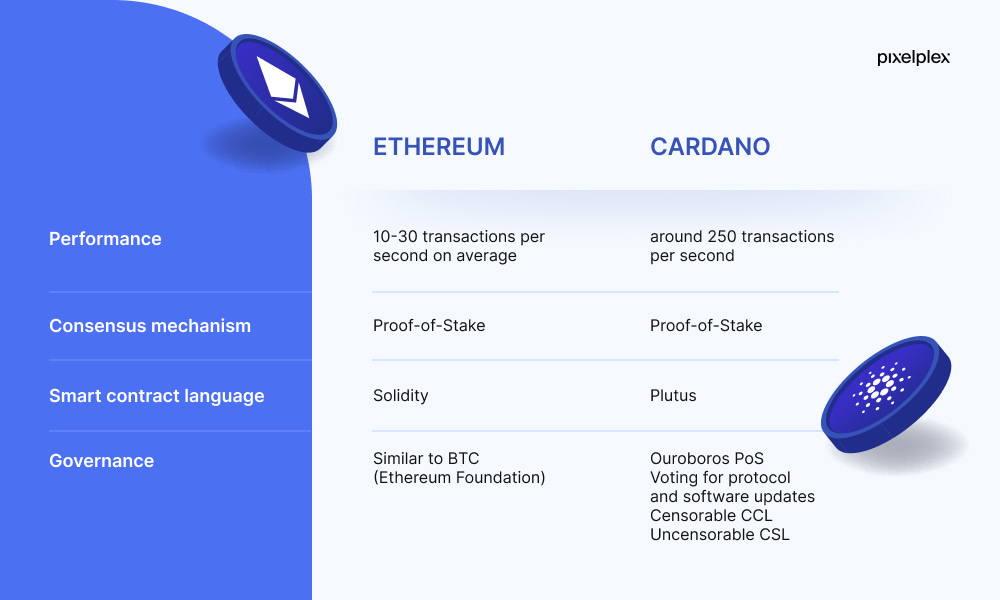
| Feature | Ethereum | Cardano |
|---|---|---|
| Launch Date | July 2015 | September 2017 |
| Founding Philosophy | World computer, rapid innovation | Academic-first, formal verification |
| Consensus Mechanism | Proof-of-Stake (since 2022) | Ouroboros Proof-of-Stake |
| Minimum Staking | 32 ETH (~$82,000) | Any amount of ADA |
| Staking Yields | ~3-4% annually | ~1.7-4% annually |
| Supply Model | Open-ended, mildly inflationary | Capped at 45 billion |
| Smart Contract Language | Solidity (Turing-complete) | Plutus (Haskell-based) |
| Transaction Fees | Variable ($2-5+) | Predictable (~$0.30 max) |
| Primary Use Cases | DeFi, NFTs, global finance | Identity, emerging markets |
| Development Pace | Faster iteration, higher risk | Methodical, peer-reviewed |
Final Thoughts
Both Ethereum and Cardano represent different visions of what blockchain can become. Ethereum prioritizes composability and market capture, while Cardano values formal verification and methodical rollout. This fundamental difference manifests in their consensus mechanisms, supply curves, fee structures, and development cultures.
As we move forward in this crypto journey, I’ll be watching closely how Ethereum’s Layer-2 ecosystem evolves and whether Cardano can convert its academic approach into mainstream traction beyond specialized use cases. The beauty of this space is that innovation continues to surprise us, and there’s room for multiple approaches to succeed.
What’s your experience with these platforms? Do you stake on either one? I’d love to hear your thoughts in the comments below!
How to Read This AAVE Price Prediction
Each band blends cycle analogues and market-cap share math with TA guardrails. Base assumes steady adoption and neutral or positive macro. Moon layers in a liquidity boom. Bear assumes muted flows and tighter liquidity.
TM Agent baseline: Token Metrics TM Grade is 72, Buy, and the trading signal is bullish, indicating solid protocol fundamentals, healthy developer activity, and positive near-term momentum. In a nutshell, Token Metrics price predictions for the next twelve months fall roughly between $70 and $320, with a base case close to $150. This is because lending TVL will continue to grow, the protocol will collect fees, and there will be some small macro tailwinds.
Affiliate Disclosure:Â We may earn a commission from qualifying purchases made via this link, at no extra cost to you.
- Scenario-based, outcomes depend on the total value of the crypto market; more liquidity and adoption make the bands bigger.
- Fundamentals: Fundamental Grade 75. 51% (Community 10%2077%, Tokenomics 10%20100%, Exchange 10%20100%, VC 10%2049%, DeFi 10%2070%)
- Technology: Technology Grade 83. 17%(Activity%2075%,%20Repository%2068%,%20Collaboration%2092%,%20Security%2078%,%20DeFi%20Scanner%)
- TM Agent summary: prices will be around $70 to $320, with a low point near $150, assuming steady lending TVL growth and stable macro conditions.
- Education only, not financial advice.
Pump.fun Fees Earned Leaderboard (Top
Not much to say about the distribution: the top three are very close to each other, and the tokens in the middle have a mix of older communities and newer streams. Several names with modest average viewers still appear due to concentrated activity during peaks.
What is Cardano? ADA Explained with Animations
FAQ
What’s so special about Cardano?
Cardano is unique due to its scientific, peer-reviewed research-driven development process, its secure two-layer architecture that separates settlement from computation, and its Extended Unspent Transaction Output (EUTxO) accounting model, which is different from the account-based model used by Ethereum. Additionally, it uses a unique, energy-efficient Proof-of-Stake consensus mechanism called Ouroboros and is programmed in Haskell, a secure programming language.
Can Cardano ADA reach $10?
Many analysts think it’s possible for Cardano to reach $10, maybe even by 2030, depending on things like the market as a whole, the growth of the ecosystem, and whether or not a Cardano ETF is approved by regulators. Some projections place the average price around $10. 37 in 2030, while others are more conservative.
Is Cardano an Ethereum killer?
Cardano supporters have long called it an “Ethereum killer” because of its fast speeds, low fees, and infrastructure that supports smart contracts. This means that Cardano is expected to replace Ethereum as the most popular smart contract blockchain.
Why is Cardano not more popular?
Multiple reasons : 1) Charles, he’s a very divisive person 2) ADA is slow to develop with its research style based growth style 3) a lot of people bought at the top right before the release of smart contracts and let’s be honest that was extremely over hyped and underperformed significantly to expectations.
