Are you confused about whether to put your hard-earned money in a CD or an IRA? You’re not alone! As someone who’s spent years navigating the sometimes murky waters of personal finance. I’ve had many friends ask me “What is the difference between CDs and IRAs?”
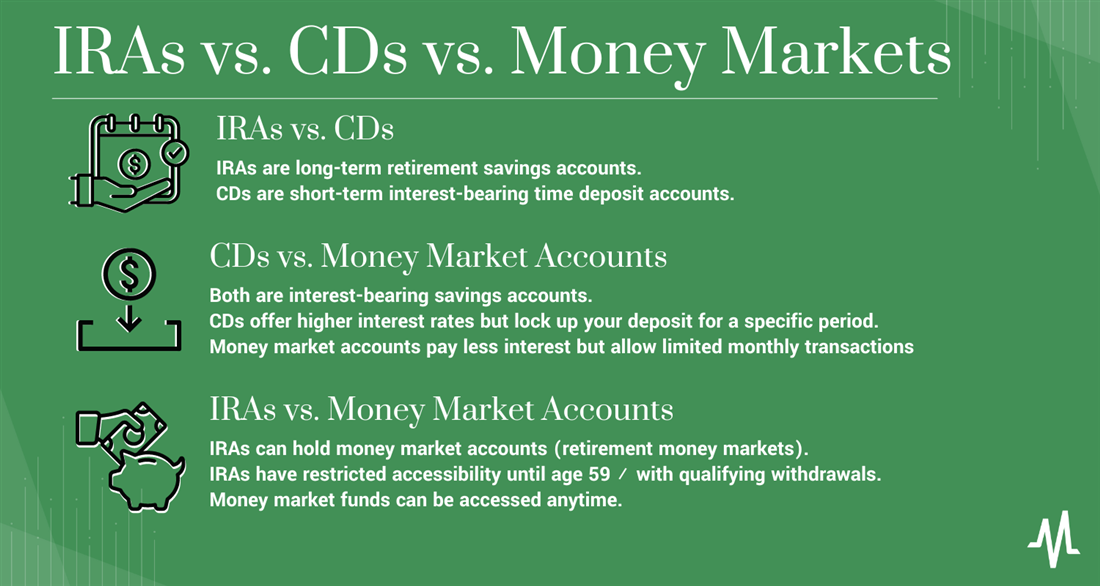
The short answer is they’re totally different financial tools designed for different purposes. A CD (Certificate of Deposit) is a savings product with guaranteed returns while an IRA (Individual Retirement Account) is an investment account with tax advantages designed specifically for retirement.
But there’s so much more to know! Let’s dive into the nitty-gritty details so you can make the best choice for your financial future.
CD vs IRA: The Basics
Before we get into the complex stuff let’s break down what these financial products actually are
Certificate of Deposit (CD):
- A type of savings account offered by banks and credit unions
- You deposit money for a specific time period (the “term”)
- The bank pays you a fixed interest rate
- Your money is locked away until the CD matures
Individual Retirement Account (IRA):
- A tax-advantaged investment account designed for retirement savings
- Can hold various investments (stocks, bonds, ETFs, and even CDs!)
- Offers tax benefits to incentivize long-term retirement savings
- Has rules about contributions and withdrawals
Key Differences Between CDs and IRAs at a Glance
| Feature | Certificates of Deposit (CDs) | Individual Retirement Accounts (IRAs) |
|---|---|---|
| Account Type | Savings product | Investment account |
| Purpose | Short to medium-term savings | Long-term retirement savings |
| Returns | Guaranteed, relatively low | Not guaranteed, variable (depends on investments) |
| Risk Level | Low risk | Varies based on investment choices |
| Term Length | 1 month to 10 years | Until age 59½ or later |
| Tax Benefits | No special tax advantages | Yes (varies by IRA type) |
| Early Withdrawal | Penalty fees apply | Penalties for withdrawals before age 59½ (with some exceptions) |
| Insurance | FDIC/NCUA insured up to $250,000 | Only deposit accounts in IRA are insured; securities are not |
| Contribution Limits | Varies by institution | Set by IRS ($7,000 in 2025 for under 50, $8,000 for 50+) |
Deep Dive into CDs
How CDs Work
When you open a CD, you’re essentially making a deal with the bank: “I’ll give you my money for X amount of time, and you’ll pay me a guaranteed interest rate.” The bank benefits by having your money to use for loans, and you benefit from a higher interest rate than you’d typically get with a regular savings account.
CD terms can range from as short as one month to as long as 10 years. Generally, the longer the term, the higher the interest rate you’ll earn. But remember, the tradeoff is that your money is locked away during that time.
Types of CDs
There are several types of CDs you might encounter:
- Standard CD: The most common type with fixed rate and term
- No-penalty CD: Allows withdrawals without penalty (but typically has lower rates)
- Bump-up CD: Lets you request a rate increase if rates go up during your term
- IRA CD: A CD held within an IRA (more on this later!)
- Jumbo CD: Requires a large minimum deposit (usually $100,000+)
Pros of CDs
- Guaranteed returns: You know exactly what you’ll earn
- Safety: CDs at FDIC-insured banks or NCUA-insured credit unions are protected up to $250,000
- Higher rates than savings accounts: CDs typically offer better rates than regular savings accounts
- Can be opened jointly: You can share a CD with another person like your spouse or child
Cons of CDs
- Limited liquidity: Your money is locked away until maturity
- Early withdrawal penalties: You’ll pay fees if you need your money before the term ends
- Lower returns: CDs generally don’t earn as much as investments in the stock market over time
- No tax advantages: CD interest is taxable in the year it’s earned
Deep Dive into IRAs
How IRAs Work
An IRA isn’t an investment itself – it’s a tax-advantaged container that holds investments. Think of it like a special box where you can put various investments (stocks, bonds, mutual funds, ETFs, and even CDs), and that box comes with tax benefits.
You open an IRA at a financial institution (bank, credit union, or brokerage), fund it, and then decide how to invest that money.
Types of IRAs
The two most common types are:
-
Traditional IRA: You contribute pre-tax dollars, which might make you eligible for tax deductions now. You’ll pay taxes when you withdraw money in retirement.
-
Roth IRA: You contribute after-tax dollars (no immediate tax benefit), but qualified withdrawals in retirement are completely tax-free!
Other types include SEP IRAs (for self-employed), SIMPLE IRAs (for small businesses), and self-directed IRAs (for alternative investments).
Pros of IRAs
- Tax advantages: Either tax-deferred growth (Traditional) or tax-free withdrawals (Roth)
- Investment flexibility: You can invest in a wide range of assets
- Higher potential returns: Historically, stock market investments have outperformed CDs over the long term
- Designed for retirement: Structured to help you save for your future
Cons of IRAs
- Investment risk: Unlike CDs, investments in IRAs can lose value
- Early withdrawal penalties: Usually 10% penalty plus taxes for withdrawals before age 59½
- Contribution limits: The IRS limits how much you can contribute each year
- Income limits for some IRAs: For example, Roth IRAs have income eligibility restrictions
Can You Combine CDs and IRAs?
Yes! This is where things get interesting. You can actually hold a CD within an IRA – this is called an IRA CD.
An IRA CD gives you the safety and guaranteed returns of a CD with the tax advantages of an IRA. It’s basically a CD that’s held inside an IRA container. This can be a good option for conservative investors or those nearing retirement who want to reduce risk while maintaining tax benefits.
Which Should You Choose: CD or IRA?
The truth is, it’s not always an either/or decision. Many people benefit from having both in their financial strategy. Here’s a quick guide on when each might be more appropriate:
Consider a CD if:
- You’re saving for a specific short-term goal (1-5 years away)
- You need a guaranteed return without risk
- You value safety over higher potential returns
- You already have retirement accounts established
Consider an IRA if:
- You’re saving for retirement
- You want tax advantages for long-term savings
- You’re comfortable with some level of investment risk
- You want the potential for higher returns over time
My Personal Experience
I’ve used both CDs and IRAs in my financial journey, and they’ve served different purposes. When I was saving for my wedding a few years back, I put money in a 2-year CD because I knew exactly when I needed the funds and wanted zero risk. Meanwhile, I’ve been consistently contributing to my Roth IRA for retirement, investing in a mix of index funds that have had their ups and downs but have grown significantly over time.
For my emergency fund, I’ve used a ladder of short-term CDs to earn a bit more interest than a savings account while still maintaining some liquidity. And yes, for a portion of my IRA that I want to be super-safe, I’ve even used an IRA CD!
How to Get Started
Opening a CD:
- Research financial institutions for the best rates
- Decide on your term length and CD type
- Complete the application (online or in-person)
- Fund your CD with an initial deposit
- Make note of the maturity date
Opening an IRA:
- Choose the type of IRA that suits your situation (Traditional or Roth)
- Select a provider (bank, brokerage, robo-advisor)
- Complete the application process
- Make your initial contribution
- Select your investments
Final Thoughts
The main thing to remember is that CDs and IRAs serve different purposes in your financial life. CDs are savings vehicles best used for short to medium-term goals, while IRAs are investment accounts specifically designed for retirement with tax advantages to match.
Many successful financial plans include both! You might have an IRA to build your retirement nest egg, while also using CDs for your emergency fund or for saving toward specific goals like a home down payment or a dream vacation.
The right choice depends on your unique financial situation, goals, timeline, and risk tolerance. And remember – your strategy can (and should) evolve over time as your needs change!
What financial tools are you currently using? Have you had experience with CDs or IRAs? I’d love to hear about your experiences in the comments below!
Disclaimer: This article is for informational purposes only and is not financial advice. Always consult with a qualified financial professional before making important financial decisions.
What is an IRA?
An IRA is a tax-advantaged investment account that individuals with taxable income can set up through a financial institution. IRAs are like 401(k) plans in that you can invest money into different assets such as stocks, bonds or mutual funds but unlike most 401(k)s, IRAs can be opened by an individual instead of an employer.
Traditional IRAs allow for pre-tax contributions, meaning you generally wont pay any taxes on your contributions until withdrawal in retirement. Roth IRAs involve contributing after-tax dollars, allowing you to make tax-free withdrawals later in life.
IRAs also come with annual contribution limits and you must typically wait until age 59 ½ to start making withdrawals without penalty, according to the IRS. In addition, you must meet certain income qualifications to contribute to a Roth IRA — if you earn too much money, you might not be able to fund one.
If you want to open an IRA, go through a reputable broker you can trust. Fidelity Investments and Vanguard both offer commission-free trading on various securities, such as stock and ETF trades, and zero or low-expense ratio index funds, making it relatively affordable to invest. Both also offer robo-advisor options for beginner investors new to the stock market.
-
Minimum deposit and balance
Minimum deposit and balance requirements may vary depending on the investment vehicle selected. No minimum to open a Fidelity Go® account, but minimum $10 balance according to the investment strategy chosen
-
Fees
Fees may vary depending on the investment vehicle selected. Zero commission fees for stock, ETF, options trades and some mutual funds; zero transaction fees for over 3,400 mutual funds; $0.65 per options contract. Fidelity Go® has no advisory fees for balances under $25,000 (0.35% per year for balances of $25,000 and over and this includes access to unlimited 1-on-1 coaching calls from a Fidelity advisor)
-
Bonus
Find special offers here
-
Investment vehicles
Robo-advisor: Fidelity Go® IRA: Traditional, Roth and Rollover IRAs Brokerage and trading: Fidelity Investments Trading Other: Fidelity Investments 529 College Savings; Fidelity HSA®
-
Investment options
Stocks, bonds, ETFs, mutual funds, CDs, options and fractional shares
-
Educational resources
Extensive tools and industry-leading, in-depth research from 20-plus independent providers
-
Minimum deposit and balance
Minimum deposit and balance requirements may vary depending on the investment vehicle selected. No minimum to open a Vanguard account, but minimum $1,000 deposit to invest in many retirement funds; robo-advisor Vanguard Digital Advisor® requires minimum $100 to enroll
-
Fees
Fees may vary depending on the investment vehicle selected. Zero commission fees for stock and ETF trades; zero transaction fees for over 3,000 mutual funds; $20 annual service fee for IRAs and brokerage accounts unless you opt into paperless statements; robo-advisor Vanguard Digital Advisor® charges up to 0.20% in advisory fees (after 90 days)
-
Bonus
None
-
Investment vehicles
Robo-advisor: Vanguard Digital Advisor® IRA: Vanguard Traditional, Roth, Rollover, Spousal and SEP IRAs Brokerage and trading: Vanguard Trading Other: Vanguard 529 Plan
-
Investment options
Stocks, bonds, mutual funds, CDs, ETFs and options
-
Educational resources
Retirement planning tools
Pros and cons of CDs
While CDs help set aside your funds for a certain period, they do come with some caveats that are important to consider.
- Guaranteed rate of return – With CDs, you agree to deposit your funds for a set duration at a fixed interest rate, ensuring a consistent return on your investment.
- Higher yield than savings accounts – CDs typically offer a higher yield than savings accounts, including some high-yield savings accounts, since you have far less flexibility of when to withdraw your money.
- No liquidity – You wont be able to access your CDs money before the end of the term without penalty.
- Early withdrawal penalty – Penalty fees associated with CDs can vary depending on your bank and your CDs term length, but theyre usually based on the interest earned or the interest you would have earned over a certain number of days or months.
What Is the Difference Between an IRA & CD?
FAQ
What is the difference between an IRA and a CD?
While IRAs and CDs are both tools for saving, but there are key differences between the two. An IRA is a retirement investing account that offers tax advantages. You can hold a range of investments in an IRA, including a CD. A CD is an account to which you deposit funds for a set period of time in exchange for a guaranteed rate of return.
Should I use a CD or an IRA?
Consider a certificate of deposit (CD) and/or an individual retirement account (IRA). Both can be a part of your diversified investment strategy, however, they’re quite different in how they work and when you might want to use one over the other. While IRAs and CDs are both tools for saving, but there are key differences between the two.
What is an IRA CD & IRA savings account?
Simply put, an IRA is a tax-advantaged account designed to help you save for retirement. You have the freedom to customize your IRA holdings according to your individual needs. IRA CDs and IRA savings accounts can provide you with the safety of steady returns and the tax advantages of IRAs.
Are CDs better than IRAS?
Both certificates of deposit (CDs) and individual retirement accounts (IRAs) can play a valuable role in your savings and investment strategy. But depending on your goals, one might serve you better than the other. It’s also possible that both CDs and IRAs have a place in your financial strategy.
Are IRA CDs the same as IRA share certificates?
However, you may not be as familiar with an IRA certificate of deposit (CD) and their credit union counterparts, IRA share certificates. An IRA CD works just like a regular CD: It’s a fixed-term savings account that offers a guaranteed rate of return. So in the simplest terms, IRA CDs are CDs can be opened inside of an IRA.
What is the difference between a CD and an Individual Retirement Account?
CDs are generally considered best for short- to medium-term needs, such as saving for a vacation or a large purchase, since they mature within months or years. An individual retirement account is a type of investment account that helps you save for retirement.
Is a CD better than an IRA?
If you have short-term savings goals, like to help pay for your wedding, a CD is likely the better fit. If you are saving for retirement, an IRA can offer better returns over the long run.
What is the average IRA balance for a 70 year old?
Are CDs the same as IRAs?
What is the biggest negative of putting your money in a CD?
