Did you know that around 8% of drivers in North Texas don’t pay their tolls? If you’re one of them, you may be wondering what happens next. Will you just receive a bill in the mail, or could unpaid tolls lead to fines, court summonses, or even jail time?
While unpaid tolls alone won’t immediately result in an arrest, ignoring toll violations, failing to pay fines, and skipping court appearances could lead to serious legal consequences. At A-EZ Out Bail Bonds, we’re here to help you understand the risks of unpaid tolls and provide support if your situation escalates.
Zipping past a toll booth without paying might seem like a small thing at the moment, but trust me, it can lead to some serious headaches down the road. I’ve researched this topic thoroughly to give you the complete picture of what happens when those toll bills go unpaid – and how you can avoid the mounting penalties that follow.
Understanding the Toll Violation Process
When you don’t pay a toll, whether it’s because you didn’t have cash on hand, your transponder malfunctioned, or you accidentally drove through an electronic toll collection point, a systematic process begins that can escalate from simple fees to legal troubles.
Initial Billing Stage
The process typically starts with a simple bill being sent to the registered owner of the vehicle. This bill includes
- The original toll amount
- A processing fee (typically around $1)
- Instructions on how to pay
At this stage, paying promptly will save you from additional headaches. Most toll authorities offer multiple payment methods including online, by phone, by mail, or in person.
Escalating Notices and Fees
If you ignore that initial bill, the situation begins to escalate:
30 Days Past Due: Notice of Non-Payment
- Original unpaid tolls
- Unpaid processing fees
- Additional $15 non-payment fee per invoice
60 Days Past Due Second Notice of Non-Payment
- All previous unpaid amounts
- Another $15 non-payment fee per invoice
90 Days Past Due Final Notice of Non-Payment
- All previous unpaid amounts
- Yet another $15 non-payment fee per invoice
Collections and Legal Action
After 90 Days: If the account remains unpaid for 90 days, the account becomes delinquent and all overdue toll transactions will be sent to a collections law firm for up to four months in an attempt to find the customer and collect payment.
After 120+ Days: This is where things get really serious. Under Texas law and similar statutes in other states, toll evasion can become a criminal misdemeanor charge. Each unpaid toll can result in:
- Criminal misdemeanor charges
- Original toll amount
- Court administrative fees
- Special fines of up to $250 PER UNPAID TOLL
Let me emphasize that last point – each individual toll transaction can result in up to $250 in fines. So if you’ve got multiple unpaid tolls, those fines can add up extremely quickly!
Severe Long-Term Consequences
Vehicle Registration Holds
Many states have agreements with their Department of Motor Vehicles (DMV) that allow them to place holds on vehicle registrations for toll violators. This means when it’s time to renew your registration, you’ll be blocked until you settle all outstanding toll debts.
License Suspension
In some jurisdictions, persistent failure to pay toll violations can eventually lead to the suspension of your driver’s license. This can create a cascade of problems including:
- Inability to legally drive
- Potential job impacts if driving is required
- Higher insurance rates when reinstated
Credit Score Impact
When toll bills are sent to collections, they can damage your credit score. This happens because:
- The collection agency reports the debt to credit bureaus
- The unpaid debt appears on your credit report
- Your credit score drops as a result
- Future loan applications may be affected
The “Habitual Violator” Status
Some states, like Texas, have implemented “Habitual Violator” programs that impose additional penalties on the worst offenders. For example, the Central Texas Regional Mobility Authority defines habitual violators as those with:
- 100+ unpaid tolls within a one-year period
These habitual violators face severe consequences:
- Vehicle registration blocks
- Vehicle bans from toll roads
- Criminal misdemeanor charges
- Fines up to $500
- Possible vehicle impoundment if caught driving on toll roads during a ban
State-Specific Enforcement
The severity of toll enforcement varies by state and toll authority. Here’s what happens in some major toll areas:
New York, New Jersey, and Pennsylvania
These states have interconnected highway systems and work together to enforce toll violations. The E-ZPass system used throughout these states makes it easier to track violators across state lines.
In New York, for example, the consequences can be particularly harsh:
- Administrative fees start at $5 per violation
- Vehicle registration suspension for repeat offenders
- Potential referral to collection agencies
Florida (SunPass)
Florida’s toll enforcement includes:
- Invoices with administrative fees
- Registration holds for unpaid tolls
- Potential license suspension for habitual offenders
Texas Toll Authorities
Texas is particularly aggressive with toll enforcement:
- Criminal charges for non-payment
- Fines up to $250 per violation plus court costs
- Habitual violator program with vehicle bans and impoundment
California Toll Roads
California toll agencies typically:
- Add penalties to unpaid tolls
- Place holds on vehicle registrations
- Refer unpaid tolls to collection agencies
Out-of-State Driver Considerations
If you’re driving out of state, don’t think you’re exempt from toll enforcement. Toll authorities have developed systems to track down and bill out-of-state drivers.
While the enforcement mechanisms may be somewhat limited across state lines (for example, one state cannot place a hold on a vehicle registered in another state), there are still consequences:
- Bills and penalty notices will still be mailed to you
- Unpaid tolls may be referred to collections
- Your credit score can be affected
- Some states have reciprocity agreements allowing them to enforce each other’s toll violations
How to Resolve Unpaid Toll Issues
If you’ve received notices about unpaid tolls, it’s important to act quickly to minimize the penalties. Here’s what you can do:
1. Pay Promptly
The simplest solution is to pay the toll as soon as possible. Most toll authorities offer multiple payment options:
- Online payment portals
- Phone payment systems
- In-person payment centers
- Mail payment options
2. Contact the Toll Authority
If you believe there’s been an error, or you need to discuss payment options:
- Call the customer service number on your violation notice
- Explain your situation
- Ask about payment plans or fee reductions
- Keep detailed records of any conversations
3. Dispute Resolution
If you have a legitimate reason to dispute a toll violation:
- Gather evidence (photos, receipts, etc.)
- Submit a written appeal to the toll authority
- Follow their specific dispute process
- Respond promptly to any requests for additional information
4. Payment Plans
Many toll authorities offer payment plans for those with multiple violations or financial hardship:
- Ask about installment options
- Get all payment plan details in writing
- Make sure you understand all terms and deadlines
Prevention Strategies
The best way to deal with toll violations is to prevent them in the first place. Here are some effective strategies:
Electronic Payment Methods
Invest in electronic toll collection devices like:
- E-ZPass (Northeast/Midwest)
- SunPass (Florida)
- TxTag (Texas)
- FasTrak (California)
- I-PASS (Illinois)
These transponders typically offer discounted toll rates and automatically deduct tolls from a prepaid account.
Account Management
If you have an electronic toll account:
- Keep your account information updated
- Ensure your payment method is current
- Maintain sufficient funds in your prepaid account
- Set up low-balance alerts
Trip Planning
Before traveling:
- Research toll roads on your route
- Estimate toll costs using online calculators
- Bring sufficient cash if electronic options aren’t available
- Consider alternate non-toll routes if necessary
Special Circumstances and Exemptions
There are some situations where toll payments might be waived or reduced:
Military Service Members
Many states offer toll exemptions or special programs for active duty military personnel. For example, the Central Texas Regional Mobility Authority offers a Qualified Service Member Program.
Emergency Vehicles
Official emergency vehicles are typically exempt from tolls when on duty.
Stolen Vehicles
If your vehicle was stolen and used on toll roads:
- File a police report immediately
- Contact the toll authority with your case number
- Submit documentation to have the tolls dismissed
Real Consequences: A Case Example
To illustrate how quickly toll violations can escalate, consider this example:
Sarah accidentally drove through five electronic tolls during a weekend trip, totaling $15 in tolls. She misplaced the bills when they arrived and forgot about them.
Original amount: $15 in tolls + $5 processing fees = $20
After 30 days: Original $20 + $75 in non-payment fees ($15 × 5 tolls) = $95
After 60 days: Original $95 + $75 more in non-payment fees = $170
After 90 days: Original $170 + $75 more in non-payment fees = $245
After 120+ days: Case sent to court with potential fines of up to $250 PER TOLL ($1,250) plus court fees and the original $245.
What started as $20 could potentially become over $1,500 in fines and fees!
My Final Thoughts
I’ve seen too many people get caught in the spiral of escalating toll violations. What starts as a simple unpaid toll can quickly transform into hundreds or even thousands of dollars in fines, legal troubles, and long-term consequences.
The toll system might seem annoying sometimes, but these fees fund road maintenance and development. The enforcement system is designed to ensure everyone pays their fair share.
If you find yourself facing toll violations, don’t ignore them – they won’t go away on their own. Take immediate action to address them before they escalate further.
The smartest approach is prevention: get an electronic transponder, keep your account in good standing, and stay aware of toll roads on your route. A little preparation can save you from major headaches down the road.
Remember that toll authorities are often willing to work with you if you’re proactive. Many offer first-time forgiveness programs or payment plans – but you have to reach out to them before things get too far along in the enforcement process.
Have you ever had to deal with unpaid toll violations? What was your experience? I’d love to hear about it in the comments!
Failure to Appear in Court (FTA)
The most likely way unpaid tolls could lead to jail time is if you fail to appear in court after being summoned.
If you receive a court notice for unpaid tolls and ignore it, the judge may issue a bench warrant for your arrest. This means you could be taken into custody if pulled over for a routine traffic stop.
Criminal Misdemeanor Charges
If you ignore multiple notices, fail to pay fines, or accumulate excessive violations, your case can escalate to a criminal misdemeanor, leading to:
- Higher fines
- Additional court fees
- Potential suspension of your vehicle registration
Ask Trooper Steve: Here’s what happens if you don’t pay a toll in a rental car
FAQ
What happens if I don’t pay my tolls?
If you don’t pay your tolls within 80 days, the vehicle’s registered owner will be sent a notice of civil penalty for $40 for each unpaid toll. If you don’t resolve the civil penalty within 20 days, the Department of Licensing may place a hold on the vehicle registration. Learn more about late fees and penalties.
What happens if a toll bill is unpaid?
Depending on your state vehicle codes, this might also impact your driving record. When toll bills remain unpaid, they can be sent to a collection agency. These agencies will attempt to recover the owed amount, which could harm your credit score and cause relentless communication attempts.
How to deal with unpaid tolls?
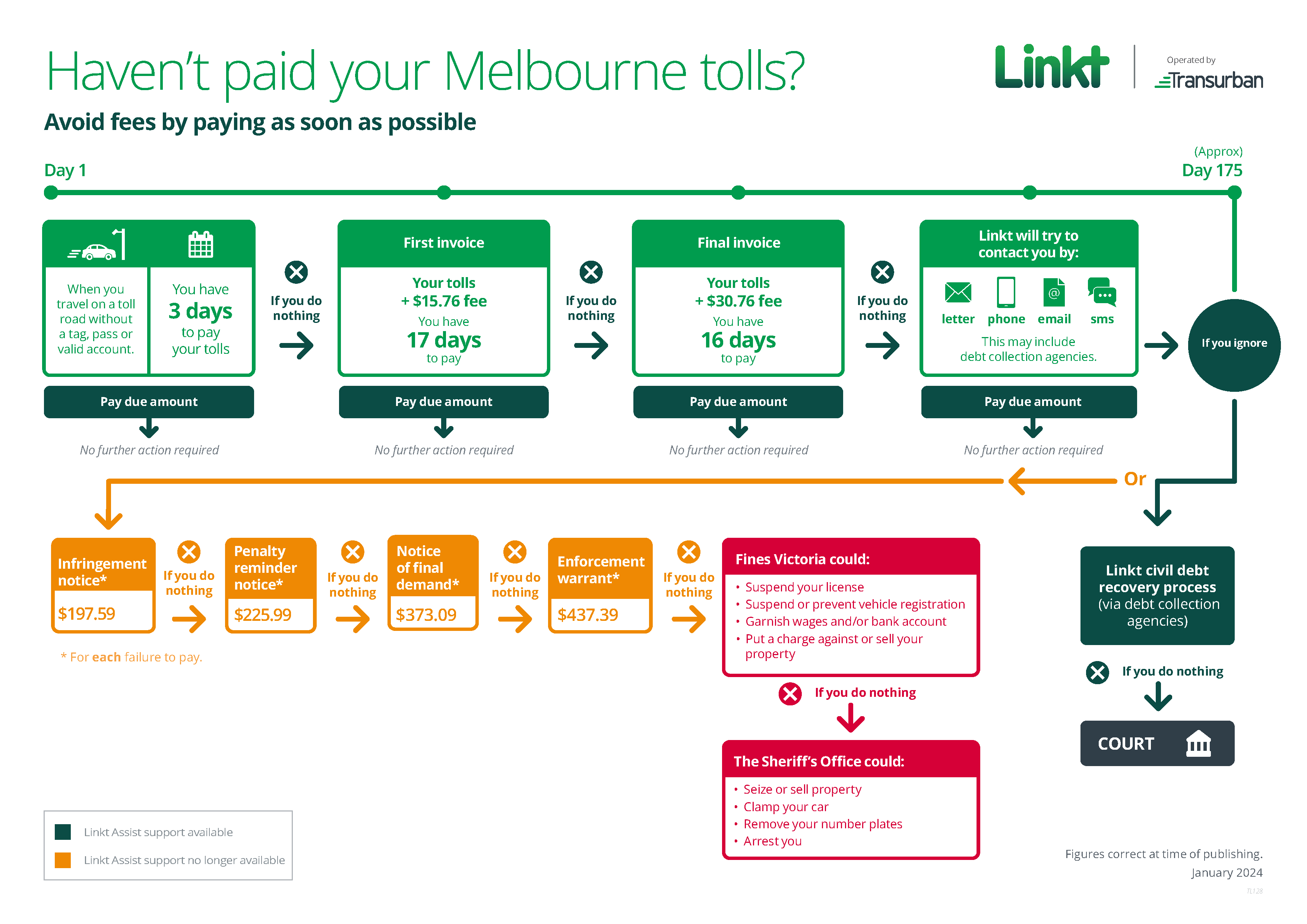
If you know the risks and possible solutions, you can deal with any unpaid tolls in the right way to avoid bigger legal and financial problems. When you go through a toll plaza or booth and don’t pay, either because you don’t have enough money or because you forgot, the tolling authority starts an administrative process right away.
What happens if a toll invoice is unpaid?
Here are the steps a Pay By Mail customer can expect if a toll invoice is unpaid: The following example illustrates how unpaid tolls can lead to serious legal issues if not resolved. Under Texas law, someone who fails to pay a toll may be charged with a criminal misdemeanor for toll evasion under Chapter 370.11 of the Texas Transportation Code.
What happens if you neglect toll bills?
If you neglect unpaid toll bills, the consequences intensify, potentially affecting your driving privileges, credit, and involvement with collection agencies or court proceedings. License/Registration Suspension – States like Florida and New York may suspend your driver’s license and vehicle registration for unpaid tolls and fees.
What happens if I miss a toll notice?
Here are some of the initial consequences you may face: Registration Hold – If you ignore the notice, a hold may be placed on renewing your vehicle registration until you pay. Late Fees – Missed toll notices will start accruing late fees the longer you wait to pay, quickly multiplying the amount owed.
Will unpaid tolls suspend your license?
Don’t Fall For It: New unpaid toll text threatening to suspend your license is a scam.
What happens if you owe toll money?
If you fail to pay or respond to the instructions on the violation notice, you may incur additional fees or a suspended vehicle registration.
Can unpaid tolls affect registration in Texas?
A Habitual Violator who has accrued 100 or more unpaid tolls and who has been issued two notices of nonpayment within a year is subject to a vehicle registration block.
