What do your financial goals look like for your 40s and 50s? Maybe youll be paying down your mortgage, covering a childs college tuition or looking ahead to retirement. Hopefully, youll have spent your 20s and 30s establishing your savings. But what can you do to save more money if you feel youre falling short?
Heres how to estimate how much money you should have saved by your 40s and 50s, plus strategies for saving more money if you need to catch up to your goals.
Turning 40 is a significant milestone in life You’ve likely established yourself in your career, maybe started a family, and hopefully begun building some wealth. But where exactly should you be financially at this stage? If you’re approaching the big 4-0 or already there, you might be wondering if you’re on track or falling behind.
I’ve worked with countless clients in this age bracket, and I can tell you that while everyone’s journey is different, there are some common financial benchmarks worth aiming for. Let’s dive into what financial experts recommend and what realistic goals look like for the average 40-year-old.
The Reality Check: Where Most People Actually Are
Before I share the ideal targets let’s acknowledge reality. While many experts recommend having three times your annual salary saved by age 40 the average U.S. household headed by those 44-49 has only $81,347 saved for retirement according to the Economic Policy Institute.
If you’re not there yet don’t panic! The second-best time to start improving your finances is today (the best time was yesterday). Many successful people hit their financial stride in their 40s and beyond.
9 Financial Milestones to Aim for by Age 40
1. Get Rid of Consumer Debt
By 40, one of your primary goals should be freeing yourself from high-interest consumer debt. This includes:
- Credit card balances
- Personal loans
- Car loans
- Student loans (ideally)
Mortgages are typically considered “good debt” because homes generally appreciate in value over time, so don’t stress if you’re still paying off your house.
Why this matters: Consumer debt eats away at your ability to build wealth. The interest you pay is money that could be growing in investments instead.
2. Establish a Robust Emergency Fund
Life throws curveballs – job loss, medical emergencies, major home repairs. By 40, you should have a well-stocked emergency fund to handle these situations without derailing your finances.
Target: 3-6 months of essential expenses in a high-yield savings account.
For example, if your monthly essential expenses (housing, food, utilities, transportation) total $4,000, your emergency fund should be between $12,000 and $24,000.
3. Ramp Up Retirement Savings
The standard recommendation from financial experts is to have three times your annual salary saved for retirement by age 40. So if you earn $60,000 a year, you should ideally have about $180,000 saved in your retirement accounts.
If you’re not there yet, focus on maximizing your contributions:
- Max out your employer-sponsored 401(k), especially if there’s a match
- Consider contributing to an IRA (Traditional or Roth)
- Take advantage of catch-up contributions if you’re behind
Remember, saving just $10 a day starting at age 22 could get you to $150,000 by age 40 (assuming 8% average returns). But even if you’re starting later, you can still catch up with more aggressive saving.
4. Build a Strong Credit Score
Your credit score opens doors to better interest rates on everything from mortgages to business loans. By 40, aim for a “good” to “excellent” credit score (720+).
Tips to improve your score:
- Pay all bills on time
- Keep credit card utilization below 30% (ideally under 10%)
- Don’t close old accounts (they extend your credit history)
- Limit applications for new credit
5. Create a Comprehensive Financial Plan
By 40, you should have a clear understanding of your financial goals and a roadmap to achieve them. This includes:
- Retirement planning
- Investment strategy
- Insurance coverage
- Estate planning basics
Many people benefit from working with a financial advisor at this stage to ensure they’re on the right track.
6. Have Adequate Insurance Coverage
As you build wealth and possibly have dependents, protecting what you’ve built becomes crucial. By 40, review and secure:
- Health insurance: Comprehensive coverage for you and your family
- Life insurance: Typically 10x your annual income if you have dependents
- Disability insurance: To protect your income if you can’t work
- Property insurance: Homeowners/renters with adequate liability coverage
- Consider long-term care insurance: Planning ahead for potential needs
7. Start Estate Planning
While it may seem premature, basic estate planning is essential by 40. This includes:
- Creating a will
- Designating beneficiaries on all accounts
- Setting up powers of attorney for financial and healthcare decisions
- Considering trusts if appropriate for your situation
Nobody likes thinking about their mortality, but these documents protect your loved ones and ensure your wishes are carried out.
8. Invest in Your Health
Your health is your true wealth, and by 40, investing in your wellbeing pays significant dividends. This means:
- Regular preventive care appointments
- Healthy eating habits
- Regular exercise
- Stress management
- Mental health care
The financial benefits are clear too – healthcare costs for preventable conditions can devastate even well-planned finances.
9. Diversify Your Investments
By 40, your investment portfolio should be more sophisticated than just contributing to a 401(k). Consider:
- A mix of retirement accounts (401(k), IRA, Roth)
- Taxable investment accounts
- Real estate (primary home and possibly investment properties)
- Alternative investments based on your risk tolerance
Your asset allocation should reflect your time horizon – you still have 20+ years until traditional retirement age, which generally allows for a growth-oriented strategy.
Catching Up If You’re Behind
If you’re approaching or past 40 and feel behind on these milestones, don’t despair! There are effective strategies to catch up:
Boost Your Income
The fastest way to accelerate your financial progress is to increase what you earn:
- Negotiate a raise at your current job
- Consider changing employers (job-hoppers often see bigger pay increases)
- Develop in-demand skills through additional training
- Start a side hustle to generate extra income
- Monetize your expertise through consulting or freelancing
Even an extra $1,000 per month can dramatically change your financial trajectory.
Accelerate Debt Payoff
Use either the debt avalanche method (paying highest interest debt first) or the debt snowball method (paying smallest balances first) to systematically eliminate debt.
Maximize Tax-Advantaged Accounts
Make full use of retirement accounts that offer tax benefits:
- 401(k) contribution limit: $23,000 in 2024
- IRA contribution limit: $7,000 in 2024
- HSA contribution limit (if eligible): $4,150 for individuals, $8,300 for families in 2024
Cut Expenses Strategically
Look for big wins in your budget:
- Housing: Consider downsizing or refinancing
- Transportation: Drive vehicles longer, buy used rather than new
- Food: Meal plan and cook at home more often
- Subscriptions: Audit and eliminate unused services
The Bottom Line
Where should you be financially at 40? Ideally, you’re debt-free except for your mortgage, have an emergency fund, are well on your way to retirement savings (with roughly 3x your salary saved), and have appropriate insurance coverage and a basic estate plan.
But the reality is that many people aren’t quite there yet—and that’s okay. Financial journeys aren’t linear, and it’s never too late to make progress.
The key is to assess where you are now honestly, create a plan for where you want to go, and take consistent action to close the gap. Your 40s can be your most powerful wealth-building decade if you approach it with intention and discipline.
Remember, personal finance is personal. Your journey doesn’t need to look exactly like anyone else’s as long as you’re making progress toward financial security and the life you want to live.
What financial milestone are you most focused on as you approach or pass 40? I’d love to hear your thoughts and questions in the comments below!
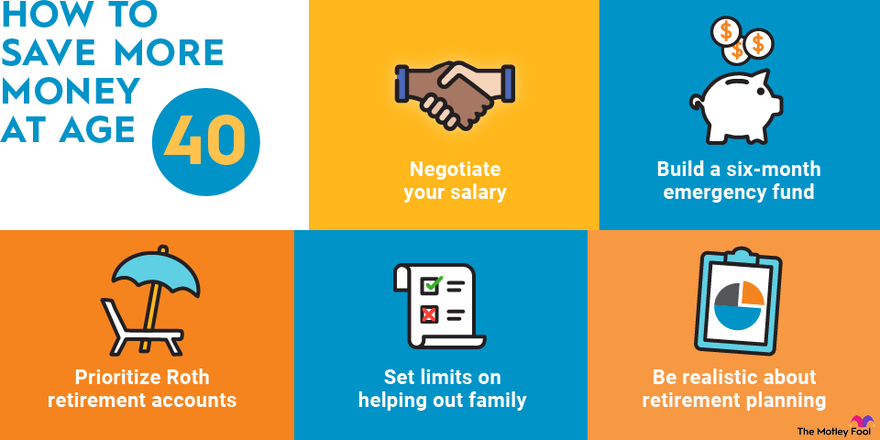
How to save more money in your 40s and 50s
If you feel youre falling short of your savings goals in your 40s and 50s, these strategies may help you catch up:
- Take advantage of retirement savings options. Hopefully, by your 40s and 50s, youre already utilizing available retirement vehicles such as a tax-advantaged IRA or 401(k). A 401(k) is an employer-sponsored retirement plan that is typically offered as part of an employee benefits package. An IRA, on the other hand, is available to all individuals, regardless of employment status. Tax-advantaged retirement plans can help your retirement savings grow over time. A 401(k) may offer you the chance to save a part of each paycheck automatically and defer taxes until youre ready to withdraw the money later in life. Whats more, many employers offer matching contributions for employees who have been with their company for a certain amount of time. With an IRA, you wont have the option of a matching contribution from your employer, but your savings can still benefit from tax-deferred growth.
- Open a high-yield savings account. For non-retirement funds, you might consider a high-yield savings account or a certificate of deposit (CD). With both of these savings options, youll benefit from compound interest, meaning any interest you earn on the account is applied to your principal savings balance. As a result, your interest earns interest, and your funds can grow more quickly than they would in another type of account.
- Try automatic deposits. Reduce the temptation to spend and maximize your savings by sending a percentage of your paycheck directly into your savings account.
- Track your finances. Theres no understating the importance of a monthly budget, including your monthly after-tax income and expenses. Make note of any unnecessary spending and look for places to cut back. For maximum impact, take the funds youve freed up and redirect them into your savings account.
- Pay off old debt and avoid new debt. Debt can chip away at your ability to save by eating up funds that could otherwise go toward your long-term financial goals. If youre struggling with significant debt, it may be a good idea to pay down some of what you owe before trying to save money. Once youve paid off old debt, youll have more room in your monthly budget to divert toward saving. Moving forward, keep loans and credit card purchases to a minimum. That way, extra funds can instead go straight to your savings goals.
If youre worried that youre not saving enough money in your 40s and 50s, dont panic. Ultimately, theres no one-size-fits-all solution, and your ability to save will vary based on your income, lifestyle and other factors. Do your best to identify your unique goals and regularly contribute to your savings so that you can achieve your financial goals and make the most of your retirement.
How much money to save by age 40 and 50
The average savings for people in their 40s and 50s varies based on earnings, living expenses, debts and overall lifestyle. So, theres no single dollar amount that can fit everyones financial situation. Instead, aim to set savings goals that are proportionate to your income.
As you reach your 40s and 50s, saving for retirement will become one of your most important goals. As a general rule of thumb, youll want to have saved three to eight times your annual salary, depending on your age:
- 40: At least three times your salary
- 45: Around four times your salary
- 50: Six times your salary
- 60: Eight times your salary
These goals include savings in retirement accounts such as a 401(k) or IRA, as well as any regular savings or checking accounts.
In addition to retirement savings, youll want to build a dedicated rainy day (or emergency) fund to cover three to six months worth of expenses. You can use this cash to pay for any unexpected costs — from medical bills to major home repairs. Having these funds on hand can help you avoid dipping into your other savings accounts or having to rely on high-interest credit cards during an emergency.
Beyond retirement savings and a rainy day fund, its generally recommended to set aside at least 20% of your after-tax income each pay period. Your additional savings might go toward paying off your mortgage, funding an education or financing home renovations.
40 Years Old and Nothing Saved For Retirement – Top 10 Recommendations
FAQ
Should investing in your health be a financial goal by 40?
Make investing in yourself and your health one of your financial goals by 40! This one is kind of a blend of a personal and financial goal! Health is one of your most precious resources, and can dramatically affect your finances for better or worse. It’s worth spending extra time and money on now, so it demands less later as you age.
What are your financial goals by 40?
Since everyone is walking their own path in life, your financial goals by 40 might not be identical to someone else’s. This goal is all about figuring out what’s important to you and making plans for those things. Do you want to buy a house (or renovate, or upgrade to a better one)? Retire early? Take a sabbatical to travel the world?
What should I do if I’m 40?
Once we hit our 40s, we should have a firm handle on our careers and have built a strong foundation for long-term financial success. To help you get a gauge on where you are, the following are simple goals that you should aim to reach by the time you are 40. 1. Reevaluate Your Priorities
Should you retire in your 40s?
If you started working in your 20s and hope to retire in your 60s, your 40s are the perfect midway point to ensure you’re prepared for your future needs. Experts recommend you try to have at least 3x your salary saved in retirement accounts by age 40.
How much money should a 40 year old save?
By age 40, aim to save at least 3x your salary; currently, $185,000 is advisable if earning $65,676. 55% of 35-44 year-olds have a retirement account, with a median balance of $60,000. To catch up on retirement savings, increase your savings rate and prioritize Roth accounts.
Is 40 a good age to pay off a mortgage?
40 is a great target age to close the book on any debts you accrued in the previous decades. This may include things like credit cards and car loans, and ideally also student loans while you’re at it! Mortgages are an exception here, although you can certainly make it a personal goal to pay off your mortgage early.
How much money should a 40 year old have in their savings?
As a general rule of thumb, you’ll want to have saved three to eight times your annual salary, depending on your age: 40: At least three times your salary. 45: Around four times your salary. 50: Six times your salary.
What is the $1000 a month rule for retirement?
Key Takeaways. The $1,000-a-month rule says you’ll need $240,000 in savings for every $1,000 monthly retirement income you want. This rule uses a 5% annual withdrawal rate and assumes your savings stay invested to grow with inflation.
Can you retire at 40 with $500,000?
As mentioned, $500,000 can last for over 30 years if budgeted correctly. However, there are a number of caveats to this, including how long you need your retirement savings to last you. For example, if you retire at 40 and need enough retirement savings for another 40 years, you may struggle.
